
Certifications we pursue, standards we already practise
For IT consulting and infrastructure, certifications are trust made auditable. Here is what each major standard means, why it matters to your business — and exactly where we stand on each, stated honestly.
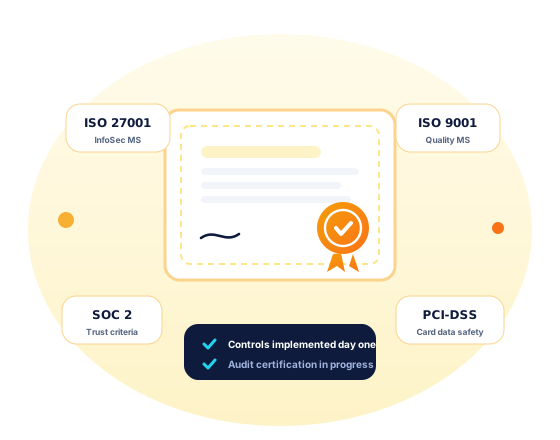
Where we stand — said plainly
Addroit Nexus is in the process of obtaining formal certification for the standards below, prioritising ISO/IEC 27001 and ISO 9001 as our audit-track certifications. Until an accredited body issues each certificate, we do not claim to be "certified" — we self-certify conformance to the standards' practices: we have implemented the controls, we run the internal audits, and we keep the evidence audit-ready.
Our internal preparation guides and self-assessment checklists are maintained openly in the project's certifications/ folder, and we are glad to walk any client or auditor through our control implementation on request. Trust, in our view, is built by showing the homework — not by borrowing a logo.
What each one means — benefits and use cases
Quality Management System (QMS)
The world's most recognised quality standard: documented processes, defined responsibilities, corrective actions and continual improvement. Benefits: fewer defects, predictable delivery, faster onboarding of new staff. Use case: demanded in government tenders and enterprise vendor empanelment; the baseline signal that a supplier runs on process, not memory.
Information Security Management (ISMS)
The global benchmark for protecting information: risk assessment, access control, incident response, supplier security and 90+ controls under Annex A. Benefits: demonstrable security posture, fewer incidents, DPDP-readiness. Use case: effectively mandatory for hosting/data-center providers and anyone handling client data at scale — our top certification priority.
IT Service Management (ITSM)
The service-management standard behind serious NOCs: incident, problem, change and SLA management done as disciplines. Benefits: tickets that resolve on pattern, not luck; measurable SLAs. Use case: managed-services and NOC contracts — how our 24×7×365 operation is structured internally.
Business Continuity (BCMS)
Keeping services alive through fire, flood, grid failure or cyber incident: impact analysis, recovery objectives (RTO/RPO), tested continuity plans. Benefits: disasters become procedures. Use case: central to our edge data-center design — DR is a product we sell, so continuity is a discipline we live.
Service Organisation Controls
A CPA-audited attestation on security, availability, confidentiality, processing integrity and privacy. Benefits: the report enterprise and SaaS buyers (especially US-linked) ask for by name. Use case: selling our SaaS and hosting to startups whose own customers demand vendor SOC 2 reports. Note: SOC 2 requires an independent auditor — it cannot be self-issued, so we say "aligned", never "attested".
Payment Card Data Security
The card industry's security standard. As a technology partner we design so that card data never touches our systems (tokenised via licensed gateways), keeping clients in the lightest compliance scope. Benefits: smaller audit surface, safer checkouts. Use case: every e-commerce and fintech build we deliver. PCI-DSS legitimately supports merchant self-assessment questionnaires (SAQ) at lower volumes — one standard where self-certification is the official mechanism.
Capability Maturity Model Integration
A maturity ladder (Levels 1–5) for engineering organisations: estimation, verification, process discipline. Benefits: predictable large-project delivery. Use case: large government and enterprise software tenders often require CMMI Level 3+ — on our roadmap as the team scales.
India's Data Protection Law
Not a certification but a legal obligation — consent, purpose limitation, grievance officer, breach response. Benefits: lawful processing, customer trust. Use case: baked into our Privacy Policy, contracts and hosting architecture (data residency in India, in-state options at the Lucknow edge).
Preparation guides and self-certification checklists for each standard are maintained in the certifications/ folder of this project — instruction sheets on how to prepare, implement and honestly self-declare conformance until accredited audits complete.
Standards are how small firms earn big-firm trust
Clients rarely read our code, and they cannot sit in our NOC at 3 a.m. What they can do is ask: which frameworks do you run on, and can you show evidence? Practising these standards today — and certifying on a public timeline — is our answer. It also makes us better: every checklist in our certifications folder has already caught real gaps before customers ever felt them.

Internal audit day: evidence first, certificates second.
Need a partner who takes standards seriously?
Tell us what you are building or what is slowing you down — we reply with a clear, honest plan.
- Response within one business day — usually much faster
- You talk to engineers, not a sales script
- Your details stay with us — see our Privacy Policy