
Services

E-Commerce that sells — and stays yours

Storefronts that load fast, marketplaces that behave, ONDC readiness before your competitors, and a D2C stack — payments, shipping, COD reconciliation, WhatsApp commerce — run by one accountable team in Lucknow.
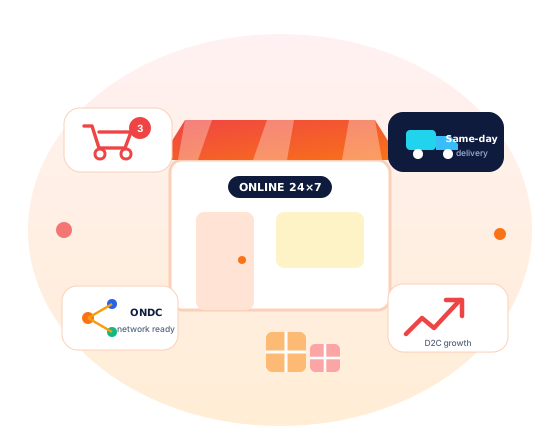
E-commerce storefront with delivery, ONDC network and growth analytics
What We Do

From first product photo to thousandth repeat order

We build and operate commerce for D2C brands, retailers and local businesses — choosing the platform by economics, not fashion, and keeping ownership of store, data and customers where it belongs: with you.

Storefronts engineered for Core Web Vitals

A slow store is an expensive billboard. We build on WooCommerce, Shopify or a custom stack depending on your catalogue and margins — but every build targets a fast first paint, clean mobile checkout and UPI-first payments, because that is where Indian carts are won or abandoned.

Customer paying online with a phone
Sales and marketing analytics dashboards

Operations, not just launches

The unglamorous work decides profitability: listing hygiene on Amazon, Flipkart and Meesho, ad spend that is reconciled against actual settlements, NDR and returns follow-ups, and COD cash that arrives when it should. We run these loops weekly and report them in one dashboard.

The Stack

Six practices, one commerce team

Storefront builds

Custom, WooCommerce or Shopify stores with mobile-first checkout, UPI/cards/COD, GST-ready invoicing and structured SEO.

ONDC readiness

Catalogue onboarding to the open network through registered network participants — discoverable on many buyer apps at lower commissions.

Marketplace operations

Amazon, Flipkart & Meesho listing hygiene, A+ content, ads management and payment-settlement reconciliation.

Shipping & COD stack

Aggregator integration, smart courier allocation, NDR workflows, returns management and COD remittance tracking to the rupee.

WhatsApp commerce

Abandoned-cart nudges, order updates and catalog-in-chat via the WhatsApp Business API — opt-in only.

Analytics & growth

GA4, pixels and server-side events wired correctly; weekly cohort, repeat-rate and contribution-margin reporting.

About ONDC: the Open Network for Digital Commerce is a government-backed open protocol — your catalogue, published once through a registered network participant, becomes discoverable across participating buyer apps. Addroit Nexus provides technology and onboarding; network participation itself runs through licensed/registered ONDC participants.
The Economics

Marketplaces rent you customers. Your store owns them.

Marketplaces are excellent discovery channels — and expensive homes. Between commission, closing fees, shipping mark-ups and ads, a large slice of every order leaves your P&L. A healthy brand runs both: marketplaces for reach, an own store for margin, repeat purchase and the customer list marketplaces will never hand you.

  • Own store: your prices, your bundles, your customer data, 0% platform commission
  • Marketplaces: managed properly — hygiene, ads, reconciliation — as a paid channel
  • ONDC: the emerging middle path — open reach at lower network fees

Where ₹100 of sales goes (illustrative)

Your D2C store
₹88–95 kept
ONDC (via participants)
₹80–90 kept
Big marketplaces
₹60–78 kept

Indicative, category-dependent; excludes your product cost & logistics. We model your actual category before recommending a mix.

Method

Launch in weeks, learn every week after

Catalogue

Products, photos, pricing, GST rates and shipping rules structured properly once.

Store

Platform chosen by economics; built mobile-first with fast checkout.

Payments

UPI, cards, wallets, COD — with settlement reconciliation from day one.

Logistics

Courier aggregation, rate cards, NDR & returns workflows configured.

Growth

SEO, ads, WhatsApp journeys and weekly margin-first reporting.

2.5s
LCP target on 4G for store pages
0%
Platform commission on your own store
99.9%
Hosting uptime target on our cloud
UPI + COD
And cards, wallets, EMI — configured right
Hyperlocal

Same-city commerce for Lucknow's own brands

Not every seller needs a national footprint. Bakeries, boutiques, pharmacies, electronics shops and grocers win on speed and trust within their own city. We combine your online store with our shop-owner SaaS apps — own-branded ordering, rider dispatch and WhatsApp updates — and, as our Lucknow edge data center comes online, the whole stack runs minutes from your counter.

  • Same-day delivery zones with live rider tracking
  • Store pickup & pay-on-pickup flows for high-trust categories
  • Hindi + English storefronts that work on entry-level phones
Local business team planning online orders together

Local sellers, national-grade tooling.

FAQ

E-commerce questions, answered

Shopify, WooCommerce or custom — how do you choose?
By margins and catalogue shape. Shopify wins on speed-to-launch with subscription and app costs; WooCommerce wins on ownership and low running cost for content-heavy catalogues; custom wins when your workflow (B2B pricing, hyperlocal delivery, heavy integrations) doesn't fit templates. We put the comparison for your case in writing before you spend.
What exactly is ONDC and are we eligible?
ONDC is an open, government-backed network where sellers list once through a registered participant and become visible across many buyer apps. Most GST-registered sellers with a structured catalogue are eligible. We prepare your catalogue, connect you through a registered participant and manage orders flowing in.
Can you migrate our existing store without losing Google rankings?
Yes — migration includes a URL map with 301 redirects, metadata and structured-data parity, sitemap resubmission and a two-week rank watch. SEO-safe migration is a checklist we publish in the proposal, not a promise we make verbally.
Who owns the store, the code and the customer data?
You do — accounts are opened in your name, code and content are handed over, and customer data lives in systems you control. If we part ways, you keep a running store and full exports. That is written into our Terms.
Do you also run the marketing?
If you want it: catalogue ads, search ads, WhatsApp journeys and email flows, all reported against contribution margin — not vanity clicks. Many clients start with launch + one growth retainer and scale from there.
People Also Ask

E-Commerce Solutions — 20 questions, answered straight

The most-asked questions on the web about this topic, answered honestly by our team.

How do I start selling online in India?
Three broad routes: list on marketplaces (fast audience, commission per sale), open your own store on a hosted platform or builder, or sell socially through WhatsApp and Instagram with payment links. Most sellers mix them. Before listing anywhere: settle your catalogue, photograph products cleanly, sort GST registration where required, and plan shipping. Start narrow — twenty well-presented products beat two hundred messy ones every time.
Do I need GST registration to sell online?
Broadly yes for marketplace selling — e-commerce operators have historically required GST-registered sellers. Since late 2023, small sellers making only intra-state supplies through e-commerce can operate unregistered within the threshold, subject to conditions and enrolment. Selling from your own website follows normal registration thresholds. The rules have moving parts and category exceptions, so confirm your specific situation with a CA before you list anywhere.
Should I sell on marketplaces or build my own website?
Marketplaces bring buyers but take commission, own the customer relationship and can change terms overnight. Your own store keeps margin and data, but you must earn every visitor yourself. The mature answer is sequencing: use marketplaces for discovery and cash flow, then move repeat buyers to your own channel where the margin lives. Businesses with existing local customers can often skip straight to their own store.
How much does an e-commerce website cost in India?
Hosted store builders run roughly ₹1,500–5,000 per month. Custom stores on open-source platforms cost ₹30,000–2 lakh to build, plus hosting and maintenance. Indicatively, Addroit Nexus builds managed online stores with UPI payments, WhatsApp updates and a flat ₹3 per-order fee (never a percentage) from ₹999 per month plus one-time setup (indicative, GST extra). Whatever the route, budget separately for photography and marketing — the website is the cheap part.
What payment options should an Indian online store offer?
UPI is non-negotiable — it dominates online checkout by transaction count. Add cards, net banking and wallets via any gateway, and cash on delivery for categories and geographies where trust is still being earned. Offer partial COD (a token online, the rest on delivery) to cut fake orders. Watch your payment mix monthly: every point moved from COD to prepaid reduces returns, working-capital strain and courier headaches.
Is cash on delivery still necessary?
Usually, yes — COD still carries a large share of Indian e-commerce, especially outside metros and among first-time buyers, though prepaid keeps growing on the back of UPI. COD costs you: collection fees, higher return rates and delayed cash. Mitigate rather than refuse: OTP-verified COD, partial advances for high-value items, and blocking COD for pincodes or customers with a history of refusals.
How does shipping work for a small online seller?
Courier aggregators are the standard answer: one dashboard connected to many couriers, discounted rates of roughly ₹25–45 per 500g depending on zone, pickup from your shop, and tracking pushed to the customer. Marketplaces mostly handle shipping for you at a fee. The numbers to manage: delivery time by zone, RTO percentage and weight disputes — photograph every parcel on a scale before handover.
What is RTO and why does it eat e-commerce margins?
RTO — return to origin — is a shipment that comes back undelivered: customer unavailable, refused, wrong address, or a COD impulse that died in transit. You pay forward and return freight, lose packaging and block inventory for weeks. Indian COD RTO commonly runs 10–30% for careless sellers. Countermeasures: address validation, WhatsApp confirmation before dispatch, partial advances, and refusing COD to repeat offenders.
How is selling on ONDC different from selling on a marketplace?
On ONDC you list once through a seller app and become visible to buyers across every buyer app on the network — the network is open, and no single platform owns the customer or sets your commission. Fees exist but are set per participant and are generally lower than marketplace commissions. It is still early: volumes vary by city and category, so treat ONDC as an additional low-cost channel rather than a replacement.
What legal pages and policies must an Indian online store have?
The Consumer Protection (E-Commerce) Rules require clear seller details, pricing inclusive of all charges, return, refund and exchange policies, delivery terms, country of origin for imports, and a grievance officer with contact details and response timelines. Add standard terms of service and a privacy policy aligned with the DPDP Act. These pages also unlock payment-gateway approval — gateways check them during merchant onboarding.
How do I get my store found on Google?
Basics first: a fast site, product pages with real descriptive text (not just a photo and price), correct product schema markup, and a Google Business Profile if you also sell locally. List products on free Google Shopping listings via Merchant Center. Content beats tricks — honest buying guides and comparison pages in your category compound for years. Paid ads can prime the pump but should not be the pump.
Can I run a store inside WhatsApp?
Substantially, yes. WhatsApp Business supports catalogues, carts and payment links; the API adds automated order confirmations and shipping updates. Small sellers run their entire funnel there — status posts for marketing, the catalogue for browsing, chat for closing. The ceiling: no search discovery, manual inventory sync, and account-ban risk if message quality slips. Pair WhatsApp with a simple web store as volumes grow.
Which platform should I build my store on?
Hosted builders are fast, with monthly fees and less control. Open-source platforms like WooCommerce have cheap licences but you own hosting and maintenance. Managed or custom builds put that burden on a vendor. Choose by the constraint you actually have: no technical staff points to hosted or managed; heavy customisation points to open or custom; tight cash flow favours monthly plans. Catalogue data migrates later; SEO only partially does.
What is cart abandonment and how do I reduce it?
Roughly 60–80% of carts everywhere are abandoned before payment. The fixable causes: surprise shipping costs, forced account creation, slow checkout and payment failures. Remedies with measurable effect: show total cost early, allow guest checkout, put UPI first, add retry flows on failure, and send a recovery nudge on email or WhatsApp within a few hours. Track your own funnel before copying anyone else's tactics.
How should I price products for marketplace selling?
Work backwards from the settlement: from your selling price subtract category commission, closing fee, shipping or weight-handling fee, payment fee, GST on all those fees, and the cost of returns at your RTO rate. What remains must cover product cost and profit. Sellers who price off MRP habitually discover single-digit or negative margins months later. Build this sheet per SKU before listing, not after.
What is TCS on e-commerce and how does it affect my cash?
Marketplaces, as e-commerce operators, collect tax at source under GST section 52 on your net sales — the rate was halved to 0.5% from July 2024. The amount appears in your GST statements and offsets your liability, so it is a cash-flow timing effect rather than an extra tax. Reconcile marketplace TCS statements monthly; mismatches between operator filings and your books are a common notice trigger.
How do I sync inventory across a marketplace, website and shop counter?
Multi-channel selling fails at stock: sell the same last piece twice and both platforms penalise you. The fix is one inventory master — your billing or ERP system — pushing stock levels to every channel through integrations, with safety buffers per channel. Even simple rules help: reserve counter stock, publish 80% online, auto-delist under a threshold. When evaluating software, ask exactly which marketplaces it syncs natively.
What e-commerce metrics should a small seller track weekly?
Sessions, conversion rate, average order value, payment success rate, COD share, RTO rate, contribution margin per order after all fees, and repeat purchase rate. Two composite numbers tell the health story: customer acquisition cost versus first-order margin, and repeat rate versus your category norm. A seller who knows these eight numbers weekly will out-decide one with ten dashboards viewed monthly.
How long does it take to launch an online store?
On a hosted builder with ready photos: a weekend. A managed store with catalogue import, payments, shipping and policies configured: one to two weeks — Addroit Nexus indicatively targets 7–14 days for standard stores, including WhatsApp integration and a staff walkthrough. Custom platform builds run 6–12 weeks. The perpetual bottleneck is content: product photos, weights and descriptions. Prepare those in parallel, not afterwards.
When should I move from marketplaces to a direct-to-customer focus?
Watch three signals: repeat purchases forming a base (customers asking for you by name), marketplace fees plus advertising exceeding 25–30% of revenue, and a category that rewards brand trust — consumables, apparel, regional foods. D2C then shifts spend from rent to asset: every customer acquired belongs to you. Keep marketplaces for discovery; move repeat volume to your own store, where the margin and the data live.
Quick Query

Have a project in mind? Let's talk.

Tell us what you are building or what is slowing you down — we reply with a clear, honest plan.

  • Response within one business day — usually much faster
  • You talk to engineers, not a sales script
  • Your details stay with us — see our Privacy Policy
Captcha code

By submitting, you agree to be contacted about your enquiry and accept our Privacy Policy. Your query is stored securely and never sold.

Get Started

Let's build something that lasts.

From a single landing page to a rack in our Lucknow edge data center — talk to a real engineer today and get a straight answer.