
SaaS Verticals

Every booking, worker and payout, on one dispatch board

Customer bookings by app, WhatsApp or a phone call, smart dispatch by locality and rating, a partner app with job cards and earnings, OTP-verified jobs, cash and UPI collection tracking and weekly payouts — the platform for small-town agencies running car cleaning, home care, salon-at-home, tutors, repairs and more. Flat subscription plus a flat ₹3 per-job service fee — never a percentage of your billing.
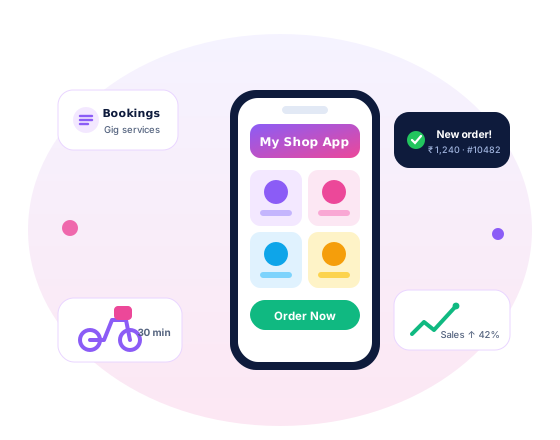
Gig worker agency automation — booking, dispatch, partner app and payouts
Built For Local Agencies

The metro apps will not come to your town. You already have.

In tier-2 and tier-3 India, home services are delivered by local agencies — one owner, a coordinator and a bench of gig workers. This platform gives that agency the same machinery the big marketplaces run, at a flat subscription instead of a 20–35% cut of every job.

Services Agencies Run On It
Car cleaning & detailing Home cleaning, cook & maid Medical care at home — visit scheduling Salon-at-home Tutors Appliance repair Photographers Laundry & dry-clean pickup Pest control
About medical care at home: Addroit Nexus provides the scheduling, dispatch and payout technology only — for attendant and nursing-visit bookings run by properly licensed agencies. Clinical services, qualified staff, medical protocols and every statutory compliance rest entirely with the licensed agency delivering the care. We keep the calendar; the licence keeps the patient.

From phone-diary chaos to a single queue

Bookings arrive however the customer prefers — the branded app, WhatsApp, or a phone call the coordinator types in — and land in one queue with service, address, slot and price. No job lives only in someone’s memory, no double-booked Sunday mornings, and the owner can see the whole day, every worker and every rupee from one screen.

Local services agency team coordinating the day around a table
The Platform

Six systems the marketplaces have — now yours

Bookings from anywhere

Customer app, web page, WhatsApp or phone-in — every booking enters one queue with slot discipline, so capture works 24×7 even when the office is closed.

Smart dispatch

Jobs auto-assign by locality, skill, current load and rating — with a coordinator override. Less travel per job means one or two more billable jobs per worker per day.

Partner app for workers

Job cards with address and details, navigation, before-and-after photos, and an earnings screen that ends every argument about pay math.

OTP job start & close

The customer’s OTP proves the worker arrived and the job finished. No-show disputes and false complaints die; actual service durations get timestamped.

Collections & weekly payouts

Cash and UPI recorded per job, a cash-in-hand ledger per worker, and weekly payouts with incentives and deductions computed — payslip visible in the app.

Quality & coverage control

Post-job ratings, rework tracking per worker, and pincode-wise service areas with slot capacity — expand town by town, deliberately.

Worker checking job cards and earnings on the partner app
The Partner App

Workers stay where pay is predictable and explained

The partner app removes the two complaints that make gig workers quit: confusion about where to go next, and doubt about how pay was calculated. Every job, every collection and every deduction is visible — which is why agencies on the platform hold on to their best workers instead of training them for a competitor.

  • Today’s job cards with service details, address and navigation
  • OTP start and close, with photos where the service needs proof
  • Cash and UPI collection recorded before a job can close
  • Earnings screen: jobs, incentives, deductions and the week’s payslip
  • Document locker for ID, police verification and skill certificates
  • Hindi and English, light enough for a ₹6–8k Android phone
The Earnings Flow

From job done to worker paid

Job closes on OTP

The customer’s close OTP confirms completed work and timestamps the duration.

Collection recorded

Cash or UPI, captured on the job card — the worker’s cash-in-hand ledger updates instantly.

Week totals up

Job earnings plus rating and peak-slot incentives, minus cash held, advances and rework penalties.

Payout with payslip

The worker sees the math in the app before money moves — weekly, predictable, explained.

Coordinator managing the dispatch console on a laptop

The owner console: one screen, whole business

Bookings by service and area, worker utilisation, cash-in-hand exposure, complaint and rework rates, repeat-customer share — the numbers that decide whether to hire, which pincode to open next and which service to push. Exportable to Excel whenever your CA or investor asks.

Indicative Pricing

Flat subscription, flat ₹3 per job

PlanBuilt forMonthly (indicative)WorkersPer-job service fee*
StarterNew agencies proving two or three services in one town₹1,499/moup to 10₹3 flat — first 33% of monthly jobs free
GrowthEstablished agencies running multi-category operations₹2,999/moup to 40₹3 flat — first 33% of monthly jobs free
ScaleMulti-town operations, franchises and custom workflowsCustomUnlimited₹3 flat — first 33% of monthly jobs free
Indicative pricing: prices are representative; GST at 18% applies extra on subscriptions, setup and per-job fees, and business customers may deduct TDS where applicable against a valid certificate. *The flat ₹3 per-job service fee bundles each job’s customer and partner notifications (1 email, up to 2 SMS, up to 2 WhatsApp utility messages, unlimited app push) plus the per-transaction infrastructure behind them — real third-party and cloud costs rolled into one predictable figure so you never juggle SMS-DLT, Meta and email vendors yourself. Every plan includes 33% of the month’s jobs free of this fee; the balance deducts from your prepaid wallet top-up, which never lapses while the subscription is active. Payment-gateway charges are billed by the gateway at published rates; setup and data loading are quoted in writing at the demo.
₹3
Flat per-job fee — a fixed rupee, never a marketplace percentage
7-day
Typical launch: services, price cards, workers and areas configured
2
Languages across customer, partner and owner screens — Hindi and English
24×7
Booking capture — the queue fills while the office sleeps
People Also Ask

Gig Worker Agency Automation — 20 questions, answered straight

The most-asked questions on the web about this topic, answered honestly by our team.

How do I start a home-services gig agency in a small town?
Start narrow: pick two or three services with steady demand — car cleaning, home cleaning and salon-at-home are proven openers — recruit 5–10 vetted workers, set clear price cards, and announce through WhatsApp, Instagram and local groups. Handle bookings on phone and WhatsApp initially; add software when volume makes manual dispatch drop jobs. Most categories need only basic trade registrations; medical-at-home needs proper clinical licensing. Unit economics first, app second.
Which home services sell best for a new agency?
Recurring beats one-off: weekly car cleaning, monthly deep cleaning, cook and maid placements, and salon-at-home have repeat rhythm built in. Appliance repair and pest control ride the seasons — summer ACs, pre-monsoon pests. Tutors and photographers carry higher tickets but longer sales cycles; laundry pickup works where density exists. The classic tier-2 winner is a car-cleaning subscription: daily visibility in society parking is free marketing.
How do gig agencies take bookings — app, WhatsApp or phone calls?
All three, into one funnel. Customers in smaller cities still call or WhatsApp first; an app or web booking page adds 24×7 capture and slot discipline. What matters is that every booking — however it arrives — lands in one system with service, address, slot and price, so dispatch sees a single queue. Agencies that run phone bookings on memory and app bookings in software leak jobs at the seam.
What is smart dispatch and how are jobs assigned?
Dispatch matches each job to the best available worker using locality (less travel, more jobs per day), skill and service type, current load, and rating. Manual dispatch works to about 10–15 jobs a day; beyond that, auto-assignment with a coordinator override wins. Locality-first assignment is the quiet profit lever: cutting average travel from 40 minutes to 15 adds one or two billable jobs per worker per day.
What does a partner or worker app actually do?
It is the worker office in a pocket: today's job cards with service details and address, navigation, customer contact, OTP-based job start and close, payment collection recording (cash or UPI), before-and-after photos, and an earnings screen showing the week's jobs, incentives and deductions. A good partner app removes the two biggest worker complaints — confusion about where to go next, and doubt about how pay was calculated.
Why do gig platforms use OTPs to start and close jobs?
The customer-shared OTP proves presence and completion: the start OTP confirms the worker reached the right customer, the close OTP confirms the customer acknowledges finished work. That one habit kills most disputes — no-show claims and jobs marked done that were not — and timestamps actual service duration for quality review. It also protects workers from false complaints. Small friction, large trust; make OTPs non-negotiable from day one.
How do agencies track cash and UPI collections by field workers?
Every job card records the amount due and the mode collected: customer UPI direct to the agency (cleanest), customer UPI to the worker, or cash held by the worker. The system keeps a running cash-in-hand ledger per worker, settled at deposit or netted against the weekly payout. Rules that keep it honest: collection recorded before job close, daily cash caps per worker, and mismatch alerts. Push customers gently toward direct UPI.
How do weekly payouts and deductions work?
The payout engine sums each worker's completed jobs at agreed rates or revenue share, adds incentives — peak slots, high ratings, referrals — and subtracts deductions: cash retained, advances, uniform or kit instalments, rework penalties. The worker sees the payslip in the app before money moves. Weekly beats monthly for gig retention, and the visible math matters more than the amounts: workers stay where pay is predictable and explained.
How do ratings and rework tracking improve service quality?
Post-job ratings per worker surface patterns fast: one 3-star is noise, a 3.6 average across 20 jobs is a training need. Rework tracking — jobs redone free after complaints — is the harder and more honest metric; it costs real money and names the exact failure. Use both for coaching and incentive tiers, not just penalties: agencies that pay rating bonuses see quality rise faster than agencies that only punish.
How should an agency recruit and verify gig workers?
Recruit where workers already are: existing service staff wanting steadier flow, referrals from current workers (pay for them), and ITI or skill-centre notice boards. Verify before the first job: ID and address proof on file, a reference check with a previous employer or customer, and police verification where the category warrants entering homes — many agencies make it mandatory for home care and maid placements. Keep documents in the worker profile; customers increasingly ask.
Are gig workers employees of the agency?
Agencies usually engage them as independent partners paid per job — India's Code on Social Security recognises gig and platform workers as a distinct category, with welfare schemes still evolving. But labels do not decide law: heavy control over hours, exclusivity and fixed wages can start to look like employment. Keep agreements written, payouts clean and records tidy, and take professional advice as you scale; classification is attracting regulatory attention everywhere.
What commission do big gig marketplaces charge — and what is the alternative?
Metro marketplaces typically keep 20–35% of each job's value from the professional, plus lead or onboarding fees in some models. The agency model flips it: workers join a local agency that owns the customer relationship and pays them per job, while the agency runs on software at a flat subscription with zero per-job commission — keeping the margin that would have gone to a marketplace, which can fund better worker pay and sharper prices at once.
What is service-area management?
Defining exactly which localities and pincodes you serve, per service, with slot capacity per area — so the booking page never accepts a job you cannot staff, and dispatch never sends a worker across the city for one job. Expansion becomes deliberate: open a new pincode when bookings cluster at its edges, seed two workers there, then widen. Agencies that stay dense per area consistently out-earn agencies that chase every enquiry.
Can one agency run many service categories on one platform?
Yes — multi-category is the small-town model, since no single vertical has metro-scale demand. The requirements: per-category price cards and job templates, per-worker skill tags so dispatch never sends a car cleaner to a salon booking, and per-category margin reports so you know what to push. Two cautions: quality dilutes beyond five or six categories, and medical-at-home is a licensed clinical operation that must be treated separately from convenience services.
How much does gig agency software cost?
Indicatively, Addroit Nexus prices its gig platform at ₹1,499 per month for a starter agency (up to 10 workers) and ₹2,999 for growth (up to 40), with custom pricing beyond that — GST extra, prices indicative, and no commission per job. Generic field-service tools sit in similar ranges but usually lack partner payouts and OTP flows. Judge any option against one number: dropped or double-booked jobs per week, before and after.
Can an agency offer medical care at home, like attendants and nursing visits?
Only as a properly licensed clinical operation: qualified and registered staff, medical protocols, and whatever registrations your state requires under clinical-establishment rules. Technology platforms — Addroit Nexus included — supply the scheduling, dispatch and payout software for such agencies; the software vendor does not provide care, and clinical responsibility and compliance rest entirely with the licensed agency. If you are not set up for that, stay with non-clinical attendant scheduling or partner with a licensed provider.
How do agencies handle complaints, refunds and rework?
With a visible, fast process: the complaint is logged against the job card with photos, answered within hours, and resolved from a menu — free rework first, then partial refund or credit. Track complaint rate per worker and per category monthly. The counterintuitive rule: a complaint handled brilliantly creates a more loyal customer than a job with no complaint at all. Budget 1–2% of revenue for make-goods; it is marketing, not loss.
Should gig workers have insurance?
Strongly advisable. Group personal-accident cover for field workers costs little per head and addresses the realistic risks — road accidents between jobs, injuries on site. Government schemes stack cheaply underneath: PMSBY and PMJJBY at trivial premiums, plus e-Shram registration for unorganised workers. Some agencies add liability cover for damage inside customer homes. Beyond decency, visible cover recruits better workers and reassures customers — advertise it openly.
How fast can an agency launch with ready-made software?
With a platform approach, indicatively about 7 days: demo, configure services and price cards, load workers and service areas, train the coordinator and workers in Hindi or English, then go live with real bookings — that is the launch path Addroit Nexus runs. The genuine prerequisites are yours, though: workers recruited, prices decided, service areas chosen. Software compresses the technology timeline; it cannot compress recruitment.
When should an agency expand to a second town?
When the first town is boringly stable: dispatch runs without the founder, workers stay (monthly churn under 10–15%), repeat bookings sit above 40%, and per-job margin holds after all make-goods. Expansion multiplies whatever exists — including chaos. The second town needs a resident coordinator, seed workers hired ahead of marketing, and the same software with a new service area, not a new system. Often, going deeper in town one out-earns town two entirely.
Quick Query

Have a project in mind? Let's talk.

Tell us what you are building or what is slowing you down — we reply with a clear, honest plan.

  • Response within one business day — usually much faster
  • You talk to engineers, not a sales script
  • Your details stay with us — see our Privacy Policy
Captcha code

By submitting, you agree to be contacted about your enquiry and accept our Privacy Policy. Your query is stored securely and never sold.

Get Started

Let's build something that lasts.

From a single landing page to a rack in our Lucknow edge data center — talk to a real engineer today and get a straight answer.