
Services

Cloud storage that keeps your data yours, in India

S3-compatible object storage, block volumes, managed backup and a deep-archive tier — triple-replicated, encrypted end to end and priced so leaving is as easy as arriving. Your first terabyte of egress every month is free.
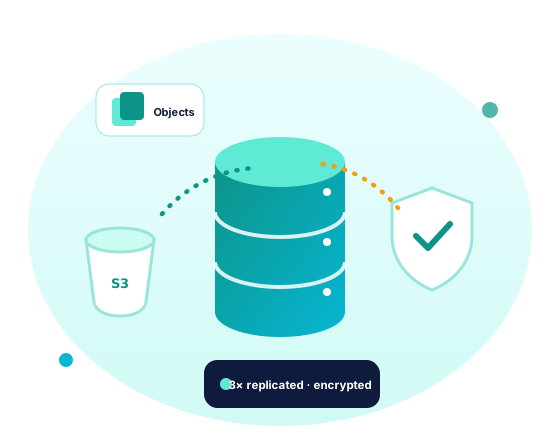
Cloud storage — S3-compatible objects, block volumes and managed backup
What We Offer

Four shapes of storage, one honest bill

Whether it is a bucket for app assets, a volume for your database, nightly backups of fifty laptops or seven years of compliance archives — it lives on the same replicated, encrypted platform in Indian data centers.

Storage priced for data that moves

Hyperscalers store your data cheaply and charge dearly the day you want it back — egress is where backup economics quietly die. We invert that: flat per-GB storage, the first 1 TB of egress free every month, and ₹3/GB after — so restore drills, media serving and migrations away from us stay affordable. Zero lock-in is a feature, not a loophole.

Reviewing storage cost analytics on a laptop
Replicated storage servers inside an Indian data center

Engineered like it holds your last copy

Every object is written to three independent nodes before we acknowledge the upload, checksummed on read, and encrypted with AES-256 at rest and TLS in transit. Versioning undoes mistakes; object-lock immutability makes backup copies that even a stolen admin key cannot delete or encrypt — the control ransomware crews hate most.

The Platform

Pick the shape, keep the guarantees

Object storage

S3-compatible buckets with presigned URLs, lifecycle rules and per-key policies. Works with the tools you already use.

Block volumes

NVMe-backed volumes that attach to our cloud servers — grow databases without rebuilding the VM.

Managed backup

Agent-based backup for servers, laptops and NAS boxes — scheduled, encrypted, verified, with humans checking the failures.

Archive tier

Half-price cold storage for CCTV footage, old projects and records you must keep but rarely read.

Data protection, standard on every byte

  • 3× replication across independent nodes
  • AES-256 encryption at rest, TLS 1.2+ in transit
  • Object versioning to undo overwrites and deletes
  • Object-lock (WORM) immutability against ransomware
  • Lifecycle rules that auto-tier and auto-expire data
  • Presigned URLs for secure, expiring share links
  • Scoped access keys per app, per team, per vendor
  • Access logging for audits and forensics
Economics

The egress tax, abolished

Storage looks cheap everywhere. The real bill arrives when you restore, serve or leave. Compare the whole picture.

Effective monthly cost — 1 TB stored + 1 TB downloaded

Indicative comparison at published list rates, converted to rupees; GST extra on all providers.

Global hyperscaler
₹9,000+
Typical Indian cloud
≈ ₹4,000
Addroit object storage
≈ ₹3,690

Addroit figure: 1,024 GB × ₹3.60 with the downloaded terabyte inside the free egress allowance. Hyperscaler figure is dominated by egress fees, not storage.

ServiceUnitIndicative Price
Object storageper GB-month₹3.60
Archive tierper GB-month₹1.80
Egressper GB₹3 — first 1 TB free every month
Backup agentper device per month₹149 (server, laptop or NAS)
Indicative pricing: all rates exclusive of GST (18%). Volume commitments above 25 TB get custom slabs — ask for a written quote, and pay by UPI, card or bank transfer.
Durable by design, priced for reality: our storage rates reflect the true market cost of enterprise flash and triple-replicated durability — every object written three times, checksummed and encrypted, on hardware bought at today’s prices. And because the first downloaded terabyte stays free each month, the number you budget is the number you pay, even on the day you need a full restore.
Residency & Ransomware

Your data sleeps in India — and cannot be silently erased

Under the DPDP Act, "where exactly is our data?" is now a board-level question. Here the answer is simple: every object and every replica lives in Indian data centers, under Indian jurisdiction — with our Lucknow edge facility joining as a storage location on our roadmap. And because immutable copies cannot be altered by anyone, including us, a ransomware crew with stolen credentials still leaves empty-handed.

  • All objects and replicas stored on Indian soil — never mirrored abroad
  • Object-lock retention: fixed-term WORM copies no key can delete
  • Versioning plus soft-delete windows for everyday human error
  • CERT-In-friendly log retention on Indian infrastructure
  • Data-processing agreement and breach-notification terms in plain English

Built to answer your auditors

DPDP Act 2023 IT Act & SPDI Rules CERT-In directions WORM / object-lock AES-256 + TLS

We are engineers, not lawyers — we implement the controls and hand your compliance team the evidence: replication reports, access logs and retention configurations.

Use Cases

What our buckets actually hold

Server & laptop backups

Nightly, encrypted, versioned — with immutable weekly copies your worst day cannot touch.

CCTV & NVR archives

Offload footage from recorders to the archive tier and keep 90–365 days affordably.

Media libraries

Video courses, podcasts and photo archives served via presigned URLs or your CDN.

App assets & static sites

User uploads, build artifacts and static frontends straight from S3-compatible buckets.

Compliance retention

Invoices, KYC records and call logs on WORM retention for exactly as long as the law asks.

DR replicas

Replicate primary systems into a second Indian region so one bad day stays a bad hour.

Restores rehearsed, not hoped for

A backup nobody has restored is a rumour. Managed-backup customers get scheduled restore drills: we pull real files from real snapshots, time the recovery, and send you the evidence — so the first true test of your backups is not the morning after a crypto-locker note.

Engineer verifying a completed restore on screen
Getting Started

Live in an afternoon, calm forever after

Create a bucket

Pick a region and retention defaults in the panel — or via the S3 API.

Generate keys

Scoped access keys per application, per teammate, per vendor.

Point your tools

rclone, Veeam, Duplicati, s3cmd and every S3 SDK work with an endpoint swap.

Relax

Replication, lifecycle rules and our 24×7×365 monitoring take it from here.

11×9s
Durability design target for replicated objects
Replicas written before an upload is confirmed
₹0
Egress surprises — first 1 TB out is free, every month
24×7
Storage platform monitored 24×7×365 by our NOC
FAQ

Cloud storage — straight answers

Will my existing S3 tools work with your storage?
Almost certainly. We speak the standard S3 API, so rclone, Veeam, Duplicati, Restic, s3cmd, Cyberduck and the official AWS SDKs all work — you change the endpoint URL and keys, nothing else. If a tool of yours misbehaves, send us its name and we will test and document it.
How does object-lock immutability actually protect me?
When you write an object with a lock period — say 30 days — no API call can modify or delete it until that period expires. Not your admin account, not a stolen key, not our support desk. Pair versioning with weekly locked copies and ransomware can encrypt your live systems yet still lose: the clean copies are untouchable.
How fast are restores when something goes wrong?
Standard object storage restores start immediately and stream at line speed — most single-server restores finish in minutes to a few hours depending on size and your bandwidth. The archive tier trades speed for price: expect retrieval readiness within a few hours. For declared emergencies, our engineers get on a call and drive the restore with you.
Where exactly is my data stored?
On our storage clusters inside established Indian data centers, replicated three ways across independent hardware — and never mirrored outside India. As our Lucknow edge facility comes online, you will be able to pin buckets to Uttar Pradesh for in-state residency and lower latency.
What does it cost to leave?
The same as staying: ₹3/GB egress after your free monthly terabyte, and nothing else — no retrieval penalties on standard storage, no per-request exit fees, no minimum tenure. We would rather keep you with pricing than with hostage economics. Write to [email protected] for a migration-out estimate; yes, we answer those too.
People Also Ask

Cloud Storage — 20 questions, answered straight

The most-asked questions on the web about this topic, answered honestly by our team.

What is cloud storage?
Cloud storage keeps your files on servers in a professional data center instead of only on your own devices, accessed over the internet. You rent capacity by the gigabyte or terabyte and the provider handles disks, redundancy and availability. Familiar consumer examples are Google Drive and OneDrive; businesses also use raw storage services, such as S3-compatible object storage, that applications and backup tools talk to directly.
Is cloud storage safe?
Generally safer than the alternatives most small businesses actually use — a single office PC or an external drive that can fail, be stolen or burn. Reputable providers keep multiple copies across disks and encrypt data in transit and at rest. The real risks are weak passwords, missing two-factor authentication and accidental over-sharing. Safety is shared: the provider protects the infrastructure, you protect the account and decide who has access.
What is the difference between file sync and backup?
Sync tools (Google Drive, OneDrive, Dropbox) mirror a folder across devices — delete or ransomware-encrypt a file on one machine and the damage syncs everywhere within seconds. Backup takes separate, versioned copies at points in time, which deletion cannot silently propagate into. Sync is for collaboration; backup is for recovery. A business needs real backup even if every file already lives in a sync service.
How much does cloud storage cost in India?
Indicatively: consumer plans start around ₹130 per month for 100 GB. Business object storage runs roughly ₹500–2,000 per TB per month depending on provider, redundancy and download terms, plus 18% GST. Watch the total cost of ownership: egress (download) and API request fees on frequently accessed data can exceed the storage line itself. Addroit Nexus shares indicative storage and backup pricing on request rather than quoting one-size-fits-all numbers.
What is the 3-2-1 backup rule?
Keep three copies of important data, on two different types of storage, with one copy off-site. For a 20-person office that could mean working files on the server, a nightly backup to a local NAS, and an encrypted copy in cloud storage in another city. The rule survives every single-point failure — disk crash, theft, fire, and even ransomware if the off-site copy is versioned or immutable.
Can cloud storage replace my office file server?
For most small offices, yes. A 20-person team typically holds 200 GB to 2 TB of documents, well within business sync-and-share or object storage plans, with per-folder permissions and no server to maintain. Two caveats: you need dependable internet (a 100 Mbps line handles routine office use comfortably), and very large files edited constantly — video projects, CAD assemblies — may still be faster on a local NAS that syncs to cloud.
Can I recover a file I deleted from cloud storage?
Usually, within limits. Most services keep deleted files in a recycle bin for around 30 days, and versioning (where enabled) preserves earlier copies of changed files. Object storage offers explicit version retention that you control. The key is to configure retention before you need it — and to keep an independent backup for truly critical data. Addroit Nexus also offers data recovery for failed local drives, a service good cloud copies make largely unnecessary.
How long does it take to upload my data the first time?
Divide data size by real upload speed. On a 100 Mbps line sustaining about 80 Mbps, 100 GB uploads in roughly 3 hours, 1 TB takes about 28–30 hours, and 10 TB needs nearly two weeks of continuous transfer. This is why initial backups are seeded overnight and across weekends, and why incremental backup — sending only changes after the first full copy — matters far more than headline storage speed.
What is the difference between file, block and object storage?
File storage organises data in folders and is what office shares and NAS devices expose. Block storage presents raw disk volumes to servers — operating systems and databases sit on it. Object storage keeps each file as an object with metadata in a flat namespace, accessed over an API, and scales to billions of objects cheaply — ideal for backups, media, logs and application assets. Most businesses end up using all three for different jobs.
What does S3-compatible mean?
Amazon S3 defined the de facto API for object storage, so S3-compatible means a service speaks that same API — buckets, objects, presigned URLs — even though it is not Amazon. The benefit is portability: thousands of tools (backup agents, WordPress plugins, Veeam, rclone, application SDKs) work unchanged against any compatible provider, and you can switch providers or keep a second copy elsewhere without rewriting your software.
What do encryption at rest and in transit mean?
In transit means data is encrypted while travelling between you and the provider, via TLS — the same technology behind HTTPS — which defeats network eavesdropping. At rest means data on the provider's disks is encrypted, typically with AES-256, so a stolen or discarded drive is unreadable. Both are table stakes now; the sharper question is who holds the encryption keys, since provider-managed keys mean the provider can technically decrypt.
Can the storage provider see my files?
With standard server-side encryption, technically yes — the provider manages the keys, though access is restricted by policy and audit trails. If that is unacceptable, use client-side or zero-knowledge encryption, where files are encrypted before upload and only you hold the key. The trade-offs are real: lose the key and the data is gone forever, and features like search, preview and easy sharing stop working on encrypted content.
Where is my data physically stored and does it matter?
Every cloud file sits on real disks in a specific country and city, which the provider should disclose as a region choice. It matters for three reasons: latency (a Mumbai region is faster from UP than a Singapore one), law (Indian sectoral rules and the DPDP Act's transfer provisions), and contracts — many Indian enterprise and government customers require India-resident data. Prefer providers that state their regions explicitly.
What are egress charges in cloud storage?
Egress is data leaving the provider's network — every download, restore or migration out. Many hyperscale providers charge roughly $0.05–0.12 per GB for it, so restoring a 2 TB backup can cost thousands of rupees at the exact moment you are already having a bad day. Some providers include free or flat-rate egress instead. Always price the restore scenario, not just the monthly storage fee.
What does 99.999999999% durability actually mean?
Eleven nines durability is a statistical claim about not losing an object: at that design level, if you stored 10 million objects you would statistically expect to lose one about every 10,000 years. It is achieved by storing each object across multiple disks and machines with checksums. Do not confuse it with availability — a service can be temporarily unreachable while your data remains intact. Durability protects existence, not access.
What is cold or archival storage?
Cold storage is priced for data you rarely read — old projects, compliance archives, CCTV footage past its review window. It costs a fraction of hot storage (often 3–10× cheaper) but retrievals can take minutes to hours and may carry per-GB fees or minimum storage durations of 30–180 days. It suits keep-for-seven-years accounting and legal records; it does not suit backups you might need to restore quickly.
How does cloud storage protect against ransomware?
Two features matter most: versioning, so files encrypted by an attacker can be rolled back to clean versions, and immutability (object lock or WORM), where backups cannot be altered or deleted by anyone — including a stolen admin account — until a set retention period ends. Combine an immutable cloud copy with tested restores and ransomware becomes an outage rather than an extinction event. Sync services alone do not provide this.
What are RPO and RTO in backup planning?
RPO (recovery point objective) is the maximum data you can afford to lose, measured in time: nightly backups give a 24-hour RPO. RTO (recovery time objective) is how quickly you must be running again. A shop billing system might accept a 24-hour RPO but need a 4-hour RTO; a hospital system may need both near zero. Set these numbers first — they, not marketing, decide which backup product fits you.
How do I move terabytes to the cloud for the first time?
Options in order of preference: seed over your existing line during nights and weekends with a throttled sync tool (rclone, restic or the provider's agent); temporarily upgrade to a faster fibre plan for a month; or use offline seeding, shipping an encrypted drive to the provider. After seeding, only incremental changes flow, which most office lines handle easily. Addroit Nexus assists backup customers in Lucknow with seeded first uploads.
What are my legal duties when storing customer data in the cloud?
Under India's DPDP Act 2023, businesses handling personal data must have consent or another lawful ground, use data only for the stated purpose, protect it with reasonable safeguards, report breaches to the Data Protection Board and affected users, and delete data once its purpose is served. Using a cloud provider does not transfer this responsibility — you remain the data fiduciary and the provider is your processor, so insist on clear written processing terms.
Quick Query

Have a project in mind? Let's talk.

Tell us what you are building or what is slowing you down — we reply with a clear, honest plan.

  • Response within one business day — usually much faster
  • You talk to engineers, not a sales script
  • Your details stay with us — see our Privacy Policy
Captcha code

By submitting, you agree to be contacted about your enquiry and accept our Privacy Policy. Your query is stored securely and never sold.

Get Started

Let's build something that lasts.

From a single landing page to a rack in our Lucknow edge data center — talk to a real engineer today and get a straight answer.