
FinTech engineering, on licensed rails
UPI checkouts, payout automation, reconciliation engines, agent networks and lending tooling — from a technology partner, not a bank. Regulated rails run through licensed providers; we make everything around them fast, auditable and boring in the best possible way.
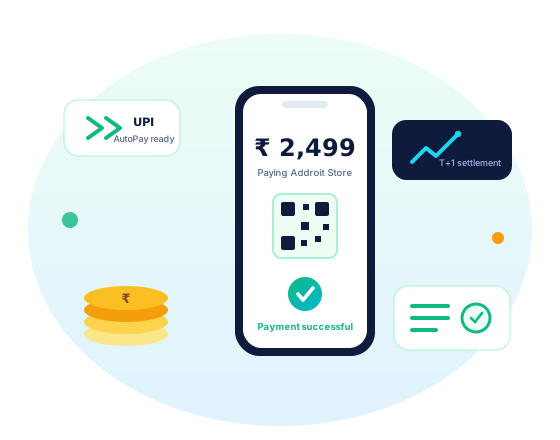
Payment systems that balance to the paisa
Most fintech projects fail after the demo — at reconciliation, certification and audit time. We build for those days first: every transaction traceable, every exception surfaced, every regulated step handled by a licensed partner.
From tap to bank credit, one traceable line
A customer pays by UPI at your counter or checkout; that rupee then crosses a gateway, a nodal account, a settlement file and your ledger. We build the software that follows it the whole way — checkout and mandate journeys on the front, webhooks, retries and T+1 reconciliation files on the back — so your accounts team sees one clean, matched line.


Built for Bharat-scale operations
Our fintech work leans towards the India that pays in UPI and cash-out at agent counters: kirana-friendly retailer apps, Hindi-first screens, collections apps that print receipts in the field, and dashboards a promoter can read on a phone. Metro-grade engineering, Tier-2 empathy — designed and supported from Lucknow.
Six things we build exceptionally well
UPI & payment-gateway integrations
Checkout, UPI intent and collect, autopay mandates, payment links and dynamic QR — wired to the aggregator or bank PG whose rates and success curves fit your volumes.
Payout & refund automation
Vendor, agent and customer refunds through partner payout APIs — approval queues, automatic retries on failure, and a state machine that never loses a rupee in limbo.
Reconciliation engines & MIS
Three-way matching across PG ↔ bank ↔ ledger with T+1 exception reports, ageing views and drill-downs — MIS your CA and your auditor will both sign off on.
Agent-network stacks
AEPS, micro-ATM and BBPS retailer apps built on licensed API providers — agent onboarding, commission ledgers, float top-ups and settlement views for networks of thousands.
NBFC & co-operative tooling
LOS/LMS-lite for small lenders and co-ops: EMI schedules, field collections app with instant receipts, bucket-wise overdue views and head-office reporting.
KYC & onboarding flows
Aadhaar-based, CKYC and DigiLocker journeys through licensed KYC providers — consent capture, graceful retries and audit-ready logs on every verification.
Close the day in minutes, not weekends
Reconciliation is where fintech operations quietly bleed hours. A purpose-built engine turns it from a weekly Excel marathon into a T+1 exception queue.
Hours per week spent reconciling payments
Indicative, for a business doing roughly 5,000 transactions a month across two gateways and a bank account.
Dashboards & MIS for founders, ops and auditors
One screen for the promoter (collections, success rate, settlement due), one for operations (exception queue, refund ageing, agent float) and one for the auditor (immutable logs, maker-checker history, downloadable registers). Same data, three honest views — refreshed as settlements land.

Five steps from scope to settled and reconciled
Fintech launches live or die on partner certification. We plan for it from day one, not as a surprise in week eight.
Scope
Map money flows, pick licensed partners, agree the compliance boundary in writing.
Sandbox
Build against partner sandboxes with realistic failure and timeout simulation.
Certify
Partner UAT and certification — we sit in the calls and clear observations fast.
Launch
Phased go-live with limits, alerting and a rollback plan nobody should need.
Reconcile
T+1 recon and exception reports from the first settlement onwards.
Built as if the auditor is already in the room
We are engineers, not compliance officers — your partners and advisors own the legal view. But we build so that their job is easy: data kept in India-region infrastructure in line with RBI data-localisation expectations, PCI-DSS-aligned practices with no raw card storage (cards stay tokenised at the gateway), and controls that assume every action will one day be questioned.
That mindset costs little on day one and saves the project when a partner audit, investor due diligence or a disputed transaction lands on your desk.
The default control set
- India-region hosting aligned with RBI data-localisation direction for payment data
- No raw card numbers stored, ever — tokenisation stays with the licensed gateway
- Maker-checker approvals on payouts, refunds and master-data changes
- Append-only audit trails: actor, timestamp, before and after values
- Role-based access, IP allow-listing and full session logs on back-office tools
- Encryption in transit and at rest; secrets in vaults, never in code
- DPDP-aware consent capture and data-retention schedules
FinTech questions, answered straight
Is Addroit Nexus RBI-licensed? Are you a bank, PSP or NBFC?
Which payment gateways and providers do you integrate?
How long does a UPI integration take?
Do you handle settlement money or float?
How do you keep payment data secure?
FinTech Solutions — 20 questions, answered straight
The most-asked questions on the web about this topic, answered honestly by our team.
What is fintech in simple words?
What is a payment gateway and how does it work?
What are typical payment gateway charges in India?
Is UPI really free for merchants?
Can a business accept digital payments without a website or app?
What is a payment link and when should I use one?
What is a soundbox and is it worth the rent?
What is BBPS (Bharat BillPay)?
What is UPI AutoPay and how do subscriptions collect automatically?
Why do payment companies ask for so many KYC documents?
When does money actually reach my account (what is a settlement cycle)?
What is reconciliation and why does it matter?
What happens in a UPI dispute or chargeback?
What is a virtual account and why do businesses use them?
Do I need an RBI licence to add payments to my app?
Is it legal to launch a lending or pay-later app in India?
What is card tokenisation and why can apps no longer store card numbers?
What is the Account Aggregator framework?
How much does it cost to integrate a payment gateway into a custom app or website?
How does GST e-invoicing connect to payment systems?
Have a project in mind? Let's talk.
Tell us what you are building or what is slowing you down — we reply with a clear, honest plan.
- Response within one business day — usually much faster
- You talk to engineers, not a sales script
- Your details stay with us — see our Privacy Policy
FinTech & Payments — latest headlines
- 55.49 crore users, 24,161.69 crore transactions, Rs 314.23 lakh crore- Digital payments in India skyrocket as UPI reaches new milestones - thepamphlet.in
- Eight Indian fintech firms feature in world's top fintech companies list for 2026 - madhyamamonline.com
- BharatPe, PhonePe and Paytm among 8 Indian fintech firms on World's Top Fintech Companies 2026 list - Udayavani
- Offline Tap-To-Pay UPI Could Soon Reach Merchant PoS Devices - BW People
- UPI Offline Payments: NPCI Plans Tap-and-Pay Transactions Without Internet - Convergence Now
Curated from public sources for your convenience — each story opens with full credit and a link to the original publisher.