
SaaS Verticals

The general store counter, fully automated

GST billing, barcode scanning on an ordinary Android phone, inventory with expiry alerts, a digital udhaar ledger with WhatsApp reminders, and your own ordering app with home delivery — one suite that runs the whole counter, built for kirana and general stores across tier-2 India. Staff trained in Hindi, live in about 7 days, no percentage commission — just a flat ₹3 per-order service fee, first 33% of monthly orders free.
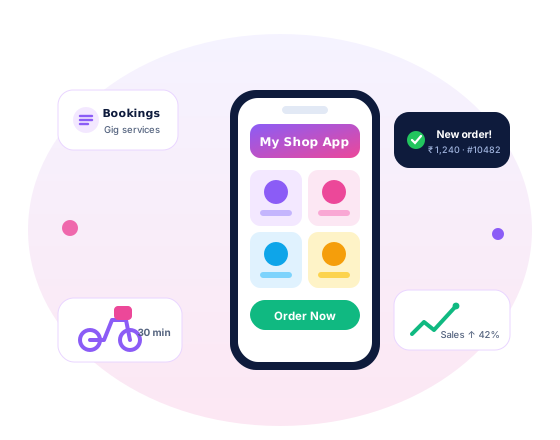
Retail and general store automation — billing, inventory, khata and ordering app
Built For The Counter

Software that respects how a shop actually runs

Kirana, general, stationery and medical-adjacent retail counters run on speed, trust and udhaar — not on keyboards and training manuals. This suite was designed at real counters in Uttar Pradesh: every screen works one-handed on a phone, in Hindi or English, with the network down.

Billing that keeps up with the rush

Scan a barcode with the phone camera, tap a quick button for loose sugar, take UPI on the same screen and the bill is done — GST-correct, stock deducted, khata updated if it was credit. A ₹10k Android phone handles a full counter; a thermal printer and laser scanner can join later when queues demand them. No costly POS tills, no annual licence shocks.

Customer paying a shop owner by UPI on a phone at the counter
Owner reviewing daily sales and margin analytics on a screen

The owner finally sees the whole shop

Every evening the suite sends the numbers that matter to the owner’s phone: sales versus last week, gross margin (not just revenue), udhaar given and recovered, top sellers and items about to run out or expire. What used to take an hour with the register now takes one glance — from the shop, from home, or from the mandi.

The Suite

Six jobs, one subscription

GST billing — B2B & B2C

CGST/SGST splits, HSN codes, bills of supply for composition shops and GSTR-ready summaries your CA can file from — every mode handled automatically.

Barcode on a ₹10k Android

Camera scanning fast enough for a real queue, quick buttons for loose items, and optional laser scanner and thermal printer when volume grows.

Inventory with alerts

Stock deducts with every bill; low-stock lists arrive before you run out, and batch-wise expiry warnings turn write-offs into planned clearance.

Udhaar / khata ledger

Credit sales post to each customer’s ledger automatically. Itemised statements and polite payment reminders go out on WhatsApp with a UPI link.

Your own ordering app

A branded app and web store with home delivery and a WhatsApp catalogue — no percentage commission — a flat ₹3 per-order service fee covers all notifications, and payments settle straight to your account.

Daily reports on your phone

Sales, margin, dues, dead stock and best sellers — pushed to the owner every evening, readable in ten seconds, exportable to Excel for the CA.

  • Offline-tolerant POS — billing and khata keep working when the network drops, then sync
  • Multi-counter and multi-branch with owner-level consolidated reports
  • Catalogue import from Excel, distributor price lists or photos of registers
  • Role-based staff logins — helpers bill, only the owner sees margins
  • Discount limits, audit trails and cash-drawer reconciliation against billed cash
  • Purchase entry with supplier dues and payment reminders
  • Hindi and English screens, switchable with one tap
  • Runs from managed Indian cloud, monitored 24×7×365
A Day With The Suite

Morning alert to evening summary

What automation feels like at an actual counter — no jargon, just the day getting lighter.

  • 7:30 AM · Before opening

    The morning stock alert

    The owner’s phone shows 14 items below reorder level and 6 batches expiring within three weeks. The distributor order goes out on WhatsApp before the shutters are fully up — nothing runs out mid-week, nothing dies on the shelf.

  • 12:30 PM · Peak rush

    The billing rush, absorbed

    Two staff bill in parallel — scan, quick-button, UPI QR, done. A regular takes ₹840 of groceries on khata with one tap. The broadband drops for twenty minutes; nobody at the counter even notices, because bills keep saving offline and sync later.

  • 9:00 PM · Shutters down

    The evening auto-summary

    Sales ₹31,240 (up 8% on last Tuesday), margin 14.2%, udhaar given ₹2,110 and recovered ₹3,450, top seller listed, and 22 online orders delivered for a flat ₹66 in order fees — not a percentage in sight. The register that used to take an hour now reads itself.

Indicative Pricing

Flat monthly, 0% order commission

PlanBuilt forMonthly (indicative)Setup (one-time)Per-order service fee*
CounterSingle-counter billing, inventory, khata and daily reports₹999/mofrom ₹4,999₹3 flat — first 33% of monthly orders free
Store + DeliveryEverything in Counter, plus your branded ordering app, WhatsApp catalogue and delivery workflow₹1,999/mofrom ₹4,999₹3 flat — first 33% of monthly orders free
Multi-branchMultiple counters and branches with stock transfer and consolidated owner reports₹3,499/mofrom ₹4,999₹3 flat — first 33% of monthly orders free
Indicative pricing: all prices are representative; GST at 18% applies extra on subscriptions, setup and per-order fees, and business customers may deduct TDS where applicable against a valid certificate. *The flat ₹3 per-order service fee bundles every order’s notifications (1 email, up to 2 SMS, up to 2 WhatsApp utility messages, unlimited app push) plus the per-transaction infrastructure behind them — genuine third-party and cloud costs rolled into one predictable rupee figure. Each plan includes 33% of the month’s orders free of this fee; the rest deducts from your prepaid wallet top-up, which never lapses while the subscription is active. Hardware (printer, scanner) and payment-gateway charges at published rates are extra. Every order is confirmed in writing with a proper GST invoice before you pay.

Demo

See the suite billing sample stock from your own trade — at your counter or on a call.

Setup

Branding, GST details and catalogue import from Excel, price lists or register photos.

Staff training in Hindi

Hands-on training for owner and staff, in Hindi or English, on your own phones.

Go live in 7 days

First real bills flowing, khata migrating customer by customer, support one call away.

₹3
Flat per-order fee on online orders — never a percentage
7-day
Typical launch from demo to first live bill
2
Languages on every screen — Hindi and English
24×7
Managed hosting, backups and monitoring included
Hands-on staff training session with the new billing system

Training and migration are part of the deal

The switch from paper is staged so the counter never stops: we load your top items first, train staff at the shop in Hindi or English, run parallel with the register for a few days, then move khata balances customer by customer. Support after go-live is a phone call or WhatsApp message away at +91 63909 99366.

Counters We Automate
Kirana & grocery General stores Medical-adjacent counters Stationery & books Bakery & sweets Cosmetics & fancy Mobile & electronics Hardware & paint
People Also Ask

Retail and General Store Automation — 20 questions, answered straight

The most-asked questions on the web about this topic, answered honestly by our team.

Do I need a billing app for my kirana or general store?
If you bill more than 30–40 customers a day, keep udhaar, or stock more than a few hundred items — yes, the payback is real: faster billing, no mental-math errors, automatic stock deduction and a clear picture of what actually sells. A tiny stall doing 20 sales a day can honestly live on a QR code and a notebook. Judge by pain, not fashion: queues, stock-outs and unpaid udhaar are the buying signals.
How much does shop billing software cost in India?
Simple mobile billing apps run free to ₹300 per month; full GST billing with inventory typically costs ₹3,000–12,000 per year; POS bundles with hardware cost more. Indicatively, the Addroit Nexus retail suite starts at ₹999 per month for a counter (billing, inventory, khata and reports) with setup from ₹4,999 — GST extra, and a flat ₹3 per-order service fee covering all customer notifications (first 33% of monthly orders included free) instead of any percentage commission. Compare on total cost including printer, training and support.
Can I use a normal Android phone as a barcode scanner?
Yes. Modern billing apps scan barcodes with the phone camera — a ₹10,000 Android comfortably handles a busy counter, and a ₹2,000–3,000 USB or Bluetooth laser scanner can be added later for rush hours. Camera scanning is genuinely fast for 30–50 bills a day; dedicated scanners win on all-day speed. Loose items without barcodes get quick buttons, search or your own printed labels instead.
How do I bill loose items like grains, sugar or cut vegetables?
Weighed and loose goods are billed through quantity shortcuts: map items to quick buttons or search, enter the weight, and the price computes from per-kg rates. At higher volumes, integrated weighing scales push weight straight into the bill. You can also print in-house barcodes for pre-packed pouches — 500g dal packs, for example — so the counter scans them like branded stock. Ask any vendor to demo with your own top 20 items.
Do small shops have to give GST bills?
It depends on registration. The general threshold for goods is ₹40 lakh turnover in most states (lower in special-category states); below it you may sell on simple bills without GST. Composition-scheme shops issue bills of supply without a tax breakup. Regular registered dealers must issue proper GST invoices with CGST and SGST splits. Good software handles all three modes — set your registration type once and every bill follows the rules. Confirm your bracket with a CA.
What is khata or udhaar software and how does it work?
It is the credit notebook, digitised: each customer gets a ledger, every credit sale posts automatically from billing, payments knock balances down, and the owner sees total udhaar outstanding at a glance. The upgrade over paper is recovery — itemised statements on WhatsApp remove disputes, and polite automated reminders collect faster than awkward phone calls. Most shops discover their real udhaar is larger than they had guessed.
Can khata apps send WhatsApp payment reminders automatically?
Yes — scheduled reminders carrying the outstanding amount, an itemised statement and a UPI link to pay instantly. Etiquette settings matter: frequency caps, quiet festival windows and personal-touch overrides for old customers, because a kirana runs on relationships. Shops using statement-plus-link reminders report noticeably faster recovery than verbal follow-ups, and the written trail politely ends arguments about what was bought and when.
How does inventory management actually help a small store?
It plugs three leaks: stock-outs of fast movers (lost sales you never see), dead stock (cash sleeping on shelves), and shrinkage (theft and unbilled sales). Software deducts stock with every bill, flags low stock before you run out, lists items unsold for 60–90 days, and shows purchase-versus-sale gaps. Even 70% catalogue discipline beats a perfect memory — start with your top 200 items and grow from there.
What are expiry alerts and which shops need them?
The system records batch and expiry dates at purchase and warns you weeks ahead — sell first, return to the distributor, or discount before the date kills the stock. They are essential for medical-adjacent counters, baby food, dairy, bakery and FMCG-heavy general stores. Expiry losses of 1–3% of stock are common and mostly invisible on paper systems; alerts turn them into planned clearance instead of quiet write-offs.
Can I take online orders from my store without paying marketplace commission?
Yes — through your own ordering channel: a branded app or web store where customers order and pay you directly, with a flat software fee plus a flat ₹3 per-order service fee (first third of monthly orders included free) — never a percentage cut. Addroit Nexus links its retail suite to exactly such an ordering app with home delivery, a WhatsApp catalogue and UPI settling to your own account (pricing indicative — see the SaaS for Local Business page). ONDC is a complementary low-fee channel worth watching in your city.
What is a WhatsApp catalogue and is it enough to sell online?
A WhatsApp Business catalogue is a browsable product list inside your business profile — free, quick to set up, and perfect for taking neighbourhood orders in chat. It is enough at low volume. Its limits: no live stock sync, manual order entry into billing, and no delivery workflow. The usual path is WhatsApp for conversation plus a proper ordering system underneath once daily orders cross a dozen or two.
Will billing software keep working if the internet goes down?
Offline-capable POS software keeps billing, khata entries and stock deduction running on the device and syncs to the cloud when the network returns — insist on this in any tier-2 or tier-3 setting. What genuinely pauses without internet: online orders, WhatsApp messages and UPI confirmations. Pair the counter with a basic UPS for power cuts and a second SIM for network cuts, and the shop rides through most outages.
What reports should a shop owner check daily?
Three numbers each evening: total sales versus yesterday and the same day last week; gross margin, not just revenue — a discount-heavy day can sell more and earn less; and udhaar given versus recovered. Weekly: top 20 sellers, dead stock and supplier dues. Good systems push a daily summary to the owner phone automatically — the habit matters more than the dashboard. A report needing more than one tap will not get read.
Can one software run two counters or a second branch?
Yes. Multi-counter setups share one catalogue and stock pool with per-counter billing; multi-branch setups keep branch-wise stock, staff and reports with owner-level consolidation. Prices typically step up per counter or branch. The discipline that makes it work is central purchasing and proper stock-transfer entries between branches — software enforces what WhatsApp coordination between two managers never will. Ask for branch-wise profit reports in the demo.
I run everything on paper. How painful is the migration?
Less than feared, if staged. Week one: bill from the new system with your top 100–200 items loaded — vendors import from Excel, distributor price lists or even photos of registers — while the paper book stays as comfort. Week two: add khata balances customer by customer as they visit. Stock counts come last, section by section. Full accuracy lands within a month without ever stopping the counter. Choose a vendor who does the first import with you.
What hardware do I need to start?
Minimum: one Android phone in the ₹10,000 class — billing, camera barcode scanning, khata and reports all run on it. Comfortable: add a ₹2,500–4,000 Bluetooth thermal receipt printer and a laser scanner for rush hour. Full desk: a basic desktop or Android POS with cash drawer, roughly ₹20,000–35,000 all-in. Start small and upgrade when queues — not salesmen — tell you to.
Is my sales data safe in a cloud billing app?
Reputable vendors encrypt data in transit and storage, take daily backups, and contractually keep your data yours — nobody browses your sales, and data is not handed to anyone without lawful process. Your GST filings, which you control, remain the tax interface. The real risks to manage: weak passwords, staff accounts that outlive employment, and vendors without export options. Ask for role-based access, activity logs and one-click Excel export.
Can billing software reduce staff theft and billing fraud?
It shrinks the dark corners: every bill is numbered and logged per staff login, discounts beyond a limit need owner approval, cash-drawer counts reconcile against billed cash, and stock deductions expose unbilled-sale patterns. Audit trails show edited or deleted bills — the classic leak. It will not catch everything, but shrinkage typically drops simply because staff know the system is watching. Set permissions on day one, not after doubts appear.
Can the software give my CA GST-ready reports?
Yes — expect GSTR-1-ready B2B and B2C summaries, HSN-wise reports, tax-rate-wise sales, and purchase registers if you record purchases. Your CA files from Excel exports or direct integrations depending on the tool. This alone removes the month-end scramble of typing bills into a spreadsheet and materially reduces mismatch notices. Confirm the exact report formats with your CA during the demo — before paying, not after.
How long does setup take, and is training available in Hindi?
Ready retail suites go live fast: indicatively, Addroit Nexus targets about 7 days — demo, then setup with catalogue import, staff training in Hindi or English at your own counter, and go-live with support on call. The honest constraint is catalogue quality: clean price lists import in a day, shoebox-of-bills situations take longer. Plan the switch for a slow weekday, run parallel with paper for a few days, then cut over.
Quick Query

Have a project in mind? Let's talk.

Tell us what you are building or what is slowing you down — we reply with a clear, honest plan.

  • Response within one business day — usually much faster
  • You talk to engineers, not a sales script
  • Your details stay with us — see our Privacy Policy
Captcha code

By submitting, you agree to be contacted about your enquiry and accept our Privacy Policy. Your query is stored securely and never sold.

Get Started

Let's build something that lasts.

From a single landing page to a rack in our Lucknow edge data center — talk to a real engineer today and get a straight answer.