
The Edge Data Center Lucknow deserves
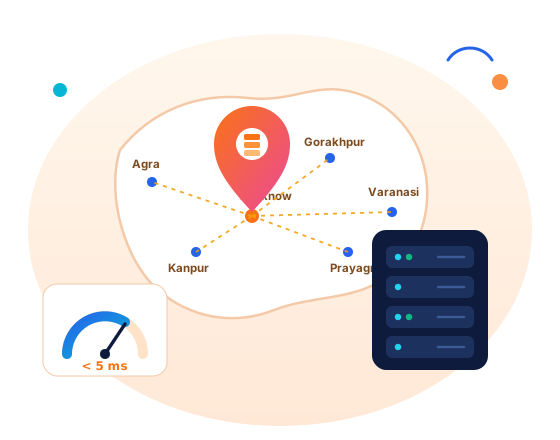
Your customers are in Lucknow, Kanpur, Varanasi and beyond — but your servers are in Mumbai, Delhi or Singapore. We are closing that gap with compact, high-quality edge capacity on Kanpur Road: colocation, cloud and connectivity with single-digit-millisecond latency across the city.
Every millisecond your data travels, your business pays
India's data centers cluster in Mumbai, Delhi-NCR, Chennai and Hyderabad. For the 24-crore-strong market of Uttar Pradesh, that means every click makes a 500–1,400 km round trip — and it shows.
Distance is latency, and latency is money
A payment confirmation, a video lecture, a POS sync, a hospital record lookup — each round-trip to a metro data center adds 25–50 ms before your code even runs. Studies across e-commerce consistently link every extra 100 ms of delay to measurable drops in conversion. An edge node in Lucknow puts compute where the request originates, cutting that journey to a few kilometres.


Bandwidth backhaul is a hidden tax
Businesses in UP pay to haul every byte to metros and back — CCTV archives, ERP backups, CDN fills, WhatsApp media. Keeping traffic local means smaller upstream bills, faster backups, and networks that keep working for local users even when a national long-haul link has a bad day.
Typical round-trip latency from a Lucknow user
Indicative RTT ranges measured over consumer broadband; actual values vary by ISP and route.
What local infrastructure does for businesses serving Lucknow & UP
Speed users feel
Sub-6 ms in-city latency makes apps feel instant — checkout, search, live classes, dashboards.
Data stays in UP
Meet customer and regulator expectations for data residency under India's DPDP regime with in-state hosting.
Lower total cost
Tier-2 power, land and manpower economics — passed on as colo and cloud pricing metros can't match.
Local hands, fast
Remote hands in minutes, not flight tickets. Swap a disk, reboot a node, escort an audit — same day.
Real DR, nearby
A disaster-recovery site far from coastal metros and on a different grid — yet 4 hours from your Delhi office by train.
Heavy data, local
CCTV/NVR archives, medical imaging, design files and media render stores stop crossing the country.
Better streaming & gaming
CDN caches and game servers at the edge cut buffering and ping for UP's fast-growing OTT and gaming audience.
Resilient by design
Keep serving Lucknow users during national backbone incidents — local traffic stays local.
Built for organisations whose users live here
If your customer base is in Lucknow or Uttar Pradesh, the edge is not a luxury — it's the correct architecture.
Software & SaaS companies
Host the latency-sensitive tier — APIs, session stores, caches — in Lucknow while keeping batch and analytics wherever they are cheapest. Your UP users get metro-grade snappiness; your DevOps gets a partner who answers the phone. Ideal for POS, ERP, school-management, clinic-management and delivery platforms sold across UP.
Hospitals, labs & clinics
PACS imaging, LIS/HIS records and telemedicine work best when the archive is minutes away, not a thousand kilometres. Local hosting supports confidentiality commitments, speeds up radiology workflows, and keeps OPD software responsive even when internet transit degrades.
Banks, NBFCs & cooperatives
Branch networks across UP need low-latency core connectivity, in-region DR and auditable physical access. An edge site in Lucknow shortens every branch round-trip and simplifies RBI-aligned data-localisation postures for payment data.
Universities, coaching & EdTech
Live classes and proctored exams are unforgiving of jitter. Host streaming origins, LMS and exam engines beside your students — Lucknow, Prayagraj and Varanasi are among India's largest test-prep markets.
E-commerce, dark stores & logistics
Quick-commerce and same-day delivery live or die on order-routing latency and printer/scanner sync at hubs. Local compute keeps rider apps, WMS and hub dashboards instant across the city.
Media, OTT, gaming & creators
Regional OTT, news and gaming audiences in UP are exploding. Edge caches and game relays in Lucknow slash startup time and ping — the difference between a subscriber and an uninstall.
Government, smart city & PSUs
Citizen services, ITMS feeds, CCTV analytics and e-governance stacks benefit from in-state hosting, sovereign data handling and vendors physically present for audits and drills.
ISPs, WISPs & cable operators
Park your CGNAT, DNS, caches and billing beside an IX-ready facility. Cross-connect locally, peer regionally, and stop hauling every DNS query to Noida.
DPDP-era architecture: keep it close, keep it clean
India's Digital Personal Data Protection Act, 2023 has made every board ask the same question: where exactly is our data? With Addroit Edge, the answer is an address on Kanpur Road — not an availability-zone code. We combine physical proximity with disciplined operations so residency is a fact, not a slide.
- Workloads and backups pinned to Indian soil, inside Uttar Pradesh
- Access logs, CCTV trails and visitor records available for your audits
- Encryption at rest and in transit as default, keys under your control on request
- Clear sub-processor terms and DPDP-aware data-processing agreements
Compliance checkpoints we design for
*Certification on our roadmap; controls implemented from day one. Nothing here is legal advice — we work alongside your compliance team.
Metro quality, Awadh economics
Land, power and skilled manpower cost meaningfully less in Lucknow than in Mumbai or NCR — and Uttar Pradesh's data-centre policy actively incentivises capacity in the state with land, stamp-duty and power benefits. We pass that structure on: expect colocation and cloud pricing typically 25–40% below metro list prices, with remote-hands included rather than billed by the visit.
Indicative monthly cost — full rack, like-for-like
Plus: no metro travel for your team, bundled remote hands, and in-state bandwidth that doesn't traverse half the country.
Services at the Lucknow edge
Colocation
1U / 2U, quarter, half and full racks. Dual power feeds, locking cabinets, labelled cabling, photographed installs.
Edge cloud & bare metal
KVM virtual machines and dedicated nodes provisioned from local stock — billed monthly, scaled in hours.
Backup & DR
S3-compatible local backup targets, replication from your metro primary, and runbook-tested restores.
CDN & cache nodes
Host your own edge caches or ours — video, static assets, OS/app updates served from inside the city.
Cross-connects & IP transit
Carrier-neutral by design: bring your ISP, cross-connect to ours, or blend. BGP sessions welcome.
Managed services
From OS patching to full application operations — the same Addroit team that builds software runs it too.
| Facility Parameter | Design Specification (Phase 1 pilot pod) |
|---|---|
| Location | Kanpur Road corridor, Lucknow — 15 min from Amausi Airport (LKO), on city fiber routes |
| Capacity | 12–24 racks pilot pod, 4–6 kW/rack average (higher on request), modular expansion in pods |
| Power | Dual feeds, online UPS (N+1), diesel generator backup with fuel contracts; target PUE ≤ 1.6 |
| Cooling | Precision in-row/DX cooling (N+1), hot/cold aisle discipline, temperature & humidity telemetry |
| Fire safety | VESDA-class early smoke detection, clean-agent suppression, zoned alarms, quarterly drills |
| Physical security | 24×7 manned entry, biometric + RFID mantrap, per-cabinet locks, 90-day CCTV retention |
| Network | Carrier-neutral meet-me area; multiple fiber entries; planned NIXI Lucknow peering; IRINN IPv4 + IPv6 with our own ASN |
| Operations | 24×7×365 NOC, 15-minute incident acknowledgement, monthly uptime & environment reports |
| Target availability | 99.9% (pilot) with a roadmap to concurrently-maintainable, Rated-3-aligned design at scale |
Design targets for the Phase-1 pilot; final as-built specifications will be published in the customer handbook at launch.
Peering, addressing and routes — done properly
A data center is only as good as its network. Our plan starts with the fundamentals: our own IRINN-allocated IPv4 and IPv6 space and autonomous system number, BGP with multiple upstreams, and peering at NIXI Lucknow so in-state traffic never leaves the state. IPv6 is first-class from day one — every service dual-stacked.
- Provider-independent IPv4 (/23 planned) + IPv6 (/32) via IRINN/NIXI
- Own ASN with multi-homed BGP — no single-carrier hostage situations
- NIXI Lucknow peering for direct routes to Indian ISPs
- RPKI-signed routes and MANRS-aligned filtering against hijacks
- DDoS posture: upstream scrubbing partners + local rate-limiting
Our IRINN affiliation pack — process guide, KYC checklist and the IP justification plan — is maintained in the project's IRINN folder and kept current with IRINN's published policy.
Uttar Pradesh is India's largest under-served digital market
Hyperscalers are building giga-campuses in Noida for national workloads. The rest of UP needs edge capacity — small, close and responsive. That's the gap Addroit Nexus fills.
From pilot pod to state-wide edge fabric
-
Phase 0 · Now
Foundations
Site shortlisting on Kanpur Road corridor, power sanction, IRINN affiliation & IP justification, anchor-tenant LOIs, detailed engineering.
-
Phase 1 · 2026–27
Pilot pod live
12–24 racks, dual power, N+1 cooling, 24×7×365 NOC. Early-access colocation, edge cloud & backup for design partners at founder pricing.
-
Phase 2 · 2027–28
Network build-out
NIXI Lucknow peering, multi-homed BGP on our ASN, CDN/cache partnerships, second pod, managed DR product.
-
Phase 3 · 2028–30
UP edge fabric
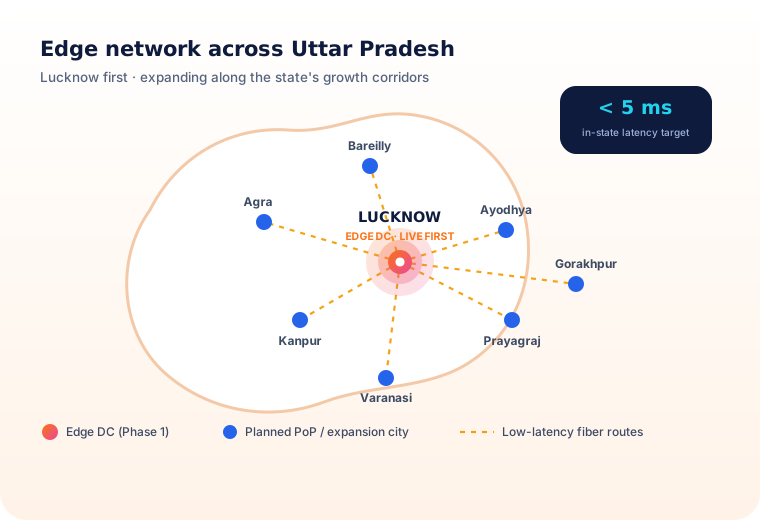
Micro-PoPs in Kanpur, Varanasi, Prayagraj & Gorakhpur interconnected over leased fiber — one contract, one dashboard, seven cities.
Edge DC — straight answers
Is the facility live today?
What makes this different from renting a VPS in Noida or Mumbai?
Can I bring my own internet provider or IP addresses?
What SLAs will apply?
How do I estimate colocation cost for my gear?
Edge Data Center — 20 questions, answered straight
The most-asked questions on the web about this topic, answered honestly by our team.
What is an edge data center?
How is an edge data center different from a big cloud data center?
Why does Lucknow need an edge data center?
What is latency and why should I care?
What is colocation?
What do rack, U and half rack mean?
What does 99.9% uptime actually mean in hours?
What are data center tiers (Tier 1 to Tier 4)?
Is an edge data center the same as a CDN?
Does it matter legally where my data is stored in India?
What is an internet exchange (IX) and what is peering?
How do data centers handle power cuts?
What is PUE in a data center?
How do data centers stay cool in North Indian summers?
Who actually uses an edge data center?
Can a small business colocate just one server?
What physical security should a data center have?
How do I connect my office network to a data center?
Can an edge data center be my disaster recovery site?
When will the Addroit Nexus Lucknow edge data center be available?
Have a project in mind? Let's talk.
Tell us what you are building or what is slowing you down — we reply with a clear, honest plan.
- Response within one business day — usually much faster
- You talk to engineers, not a sales script
- Your details stay with us — see our Privacy Policy
Cloud & Data Centers — latest headlines
- India’s Data Centre Capacity Set to Quadruple by 2030: Rubix Data Sciences Report - Convergence Now
- Sovereign by Design: Rebuilding the Cloud Stack for India’s AI Era - CXOToday.com
- India Healthcare Cloud Computing Market Size and Statistics – 2035 - Market Business Insights
- Tier-2 and Tier-3 Cities as Emerging Hubs in India’s Data Center Growth Story - Nasscom
- AWS Breaks Ground On New Hyderabad Data Centre, Reaffirms Over $21 Billion India Cloud And AI Infrastructure Investment By 2030 - Swarajya
Curated from public sources for your convenience — each story opens with full credit and a link to the original publisher.