
Services

Your business. Your app. No percentage commission.

Ready-to-run SaaS for shop owners, small-town gig companies and hardware service businesses — your own branded app with UPI payments, WhatsApp updates and Hindi plus English screens, live in about a week. Marketplaces keep 20–35% of every order; our platforms charge a flat monthly subscription plus a simple flat ₹3 per-order service fee — never a percentage of your sale.
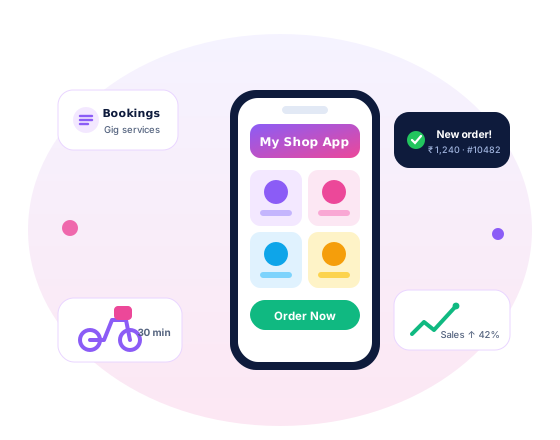
SaaS platforms for shops, gig companies and field-service businesses
Signature Platforms

Three platforms for the businesses that actually run Bharat

Kirana stores, gig-service companies and hardware shops keep every Indian town moving — and pay marketplaces dearly for the privilege of reaching their own customers. We build them their own software instead.

01 · Shop Owners

Orders & delivery on your own branded app — not a marketplace listing

For kiranas, bakeries, pharmacies, sweet shops and boutiques: customers order from your app or web store, pay by UPI straight into your account, and your own delivery boy or counter handles fulfilment. No percentage cut per order, no fighting for ranking against the shop across the road, no marketplace between you and a customer you have served for ten years.

Customer paying a local shop owner by phone using UPI
  • Your name, logo and colours on the app and web store
  • Delivery, pickup or in-store orders with time slots
  • UPI, cards and cash-on-delivery — settlements go to your account, not ours
  • WhatsApp order confirmations and status updates to customers
  • Catalog and price-list import from Excel or photos — we do the first load with you
  • Delivery-rider view with route list and cash summary
  • Repeat-customer offers and simple loyalty points
  • No percentage commission — a flat subscription plus a flat ₹3 per-order service fee that bundles every customer notification
Local services team planning bookings and dispatch together
02 · Gig-Service Companies

Booking, dispatch and a partner app — for the multi-service company in a small town

Electrician, plumber, salon-at-home, tuition, photography — one local company, many services. The metro apps will not come to your town for years; your customers are already calling. Our gig platform gives you the same machinery the big names run: slot booking, dispatch by area and skill, and a clean partner app for the people doing the work.

  • Customer app and website with service catalog and slot booking
  • Dispatch console — assign jobs by pincode, skill and availability
  • Partner app: job feed, navigation, earnings and document locker
  • Per-service pricing with visit charges and add-ons
  • UPI and cash collection recorded per job, with partner-wise commission ledgers
  • Ratings, job photos and complaint tickets on every booking
  • Pincode-wise coverage control as you expand town by town
  • Owner dashboard: bookings, cancellations, partner earnings and repeat rate
03 · Hardware & IT Service Businesses

AMC to job card — a field-service suite for computer and hardware shops

If you sell, repair or maintain computers, printers, CCTV, UPS or networking gear, your real product is the service contract. Our field-service suite runs the whole cycle: AMC contracts with renewal reminders, tickets with SLA timers, job cards your technician fills on site, parts and warranty tracking, and a GST invoice at the end — without a single paper register.

Technician workspace with computer hardware and tools
  • AMC contracts with automatic renewal reminders on WhatsApp and email
  • Ticketing with SLA timers, priorities and escalation
  • Job cards with photos, parts used and customer OTP sign-off
  • Field-technician app with day route, attendance and job history
  • Parts inventory with serial numbers and warranty tracking
  • GST invoices, quotations and payment links from the same screen
  • Customer asset history — every machine, every visit, every part
  • MIS: technician productivity, AMC renewals due, revenue by customer
One Platform Underneath

Built for Indian shops, not Silicon Valley demos

All three products share the same battle-tested base — designed around cheap Android phones, patchy networks and staff who have never used a CRM.

Your brand, front and centre

Your name, logo and colours everywhere. Customers install your app — Addroit stays invisible.

UPI money, straight to you

Payments settle to your own account via your payment gateway. We never sit in the money flow.

WhatsApp order updates

Confirmations, out-for-delivery alerts, AMC reminders and payment links — on the app every customer already opens.

Hindi + English screens

Every customer and staff screen ships in both languages; your team switches with one tap.

Runs on ₹6k Android phones

Light builds, small downloads, low RAM appetite — tested on the phones your staff actually carry.

Offline-tolerant by design

Billing and job cards keep working when the network drops, then sync automatically when it returns.

Owner analytics

Daily sales, best sellers, repeat customers and dues — one honest morning screen for the owner.

Hosted & watched 24×7×365

Indian cloud hosting, backups that restore, and monitoring by the same Lucknow team that built it.

The Commission Math

What ₹100 of sales leaves in your pocket

Indicative comparison — marketplace commissions, ads and collection fees vary by category and city, but the direction never changes.

Your own Addroit app
₹95–98
Food-delivery marketplace
₹65–75
E-commerce marketplace
₹70–82

On your own app the deductions are the payment-gateway charge (typically 0–2%, billed by the gateway at published rates) and our flat ₹3 per-order service fee — a fixed rupee amount that covers all order notifications, never a percentage, however large the order. Marketplace figures reflect indicative 20–35% commissions plus ads and collection fees.

₹3
Flat per-order fee — never a percentage of your sale
7-day
Typical launch, from demo to your first live order
2
Languages out of the box — Hindi and English
24×7
Managed hosting and monitoring included
Indicative Pricing

Flat monthly. Flat ₹3 per order.

PlatformBuilt forMonthly (indicative)Setup (one-time)Per-order service fee*
Shop AppKiranas, bakeries, pharmacies, boutiques taking orders and delivery₹999/mofrom ₹4,999₹3 flat — first 33% of monthly orders free
Gig PlatformMulti-service companies — booking, dispatch and partner app₹2,499/mofrom ₹14,999₹3 flat — first 33% of monthly orders free
Field-Service SuiteHardware and IT service businesses — AMC, tickets, job cards₹1,999/mofrom ₹9,999₹3 flat — first 33% of monthly orders free

*All prices indicative. GST at 18% applies extra on subscriptions, setup and per-order fees; business customers may deduct TDS where applicable under the Income Tax Act against a valid certificate. Payment-gateway charges are billed by the gateway at its published rates. Custom modules quoted separately.

What the flat ₹3 per-order fee includes — and why it exists: every order your app takes triggers real work and real third-party services: an order-confirmation email, up to 2 SMS and up to 2 WhatsApp utility messages to your customer and delivery partner, unlimited in-app push updates, plus the compute, storage, security and monitoring that scale with every transaction. Rather than asking you to maintain separate SMS-DLT, WhatsApp Business, email and cloud accounts, we bundle these third-party and infrastructure costs into one predictable rupee figure. Every subscription plan includes 33% of your monthly orders free of this fee — it applies only to the remaining orders and is deducted from your prepaid wallet top-up, so there is never a surprise bill. Wallet balances never lapse while your subscription is active, and a full usage statement accompanies every GST invoice.

Demo

See the platform running with sample data from your own trade.

Brand

Your name, logo, colours and business details go on everything.

Import

We load your menu, catalog or AMC book from Excel, photos or old bills.

Launch — day 7

App live, staff trained in Hindi or English, first orders flowing.

Grow

Offers, WhatsApp campaigns and analytics reviews as you scale.

FAQ

Straight answers for busy owners

Do I need technical staff to run this?
No. If your team can use WhatsApp, they can run the platform — that is the design bar we test against. We train your staff at launch (in Hindi or English), the owner screens work on any phone, and support is a phone call or WhatsApp message away at +91 63909 99366.
Who owns the customer data — you or me?
You do, unambiguously. Customer numbers, order history and analytics belong to your business; you can export everything to Excel whenever you like. We never sell, share or use your customer data for anything else, and we handle it in line with India’s DPDP framework. That is the whole point of leaving marketplaces — the customer relationship comes home.
Will my app be on the Play Store?
Yes. We publish the Android app on a developer account in your business name (we set it up with you), so the listing — like the customers — is yours. A web store link works instantly for customers who prefer not to install anything, and an iOS build via the web app is available where the audience justifies it.
Can you add features specific to my business?
Yes. The subscription covers the standard platform, which is deliberately deep for each trade. Anything special — a wholesale price list, society-gate delivery passes, a custom report your CA wants — is scoped and quoted separately as a one-time module, and then it is yours.
What happens when the internet goes down at my shop?
The counter keeps working. Billing and job cards run offline on the device and sync automatically when the connection returns; customer notifications queue and send on reconnection. Your app and web store stay online throughout, because they run from our managed cloud, not from your shop’s connection.
Ready-Made Verticals

Automation suites for your exact business

Pre-configured platforms with their own detailed pages, pricing logic and top-20 FAQs.

Retail & General Store Automation

GST billing, inventory, udhaar/khata ledger, barcode on a phone, WhatsApp catalogue and reorder alerts for kirana & general stores.

Explore the suite

Travel Agency Automation

Itinerary builder, quotations, bookings & advances, vendor management, visa checklists and post-trip follow-ups.

Explore the suite

Gig Worker Agency Automation

Car cleaning, home care, medical-at-home visits, salon-at-home, tutors & repairs — booking, dispatch, partner app and payouts.

Explore the suite

Arogya Suite — Healthcare Automation

Small hospitals, clinics and medical stores: OPD/IPD, appointments, EMR-lite, pharmacy billing with expiry & schedule-drug registers, ABDM-ready.

Explore the suite

Zaika Suite — Restaurant & Food Business

Restaurants, dhabas, cloud kitchens, fine dine, cafés and sweet shops — QR ordering, KOT/KDS, recipe costing, aggregator reconciliation.

Explore the suite

BhoomiCRM — Real Estate Automation

Built around the real challenges of small Indian developers & brokers: leads, inventory, site visits, bookings, demand letters, channel-partner commissions, RERA-ready docs.

Explore the suite

LekhaDesk — Accounting & Compliance Firms

For CA firms, accountants, tax advocates & GST practitioners: a website live in 10 minutes with lead capture on every page, plus client & compliance tracking backoffice.

Explore the suite

Sanchar Suite — Local ISP Operations

FTTH operators, cable broadband LCOs & wireless ISPs: subscriber & KYC/CAF management, renewals via UPI & WhatsApp, field staff geo-tracking, and RADIUS/MikroTik/OLT integrations.

Explore the suite
People Also Ask

SaaS for Local Business — 20 questions, answered straight

The most-asked questions on the web about this topic, answered honestly by our team.

What does SaaS actually mean for a small business?
SaaS — software as a service — means you rent software over the internet instead of buying it outright. You pay a monthly or yearly subscription, the vendor hosts and updates everything, and you log in from a phone or computer. For a shop or agency, that turns a ₹2–5 lakh software project into a predictable expense of a few hundred or thousand rupees a month, with backups and upgrades handled for you.
Does a kirana or general store really need its own app?
Not always. If your customers are walk-ins and you rarely deliver, a billing system plus a WhatsApp catalogue may be enough. An own app starts paying off when you take regular phone orders, run home delivery, or lose orders to marketplace apps. A useful rule of thumb: if staff spend an hour a day taking orders over calls and paper, an ordering app usually recovers its cost quickly.
What is zero-commission ordering?
On marketplaces, every order costs you a commission — often 20–35% in food delivery and 15–30% on product marketplaces once fees and ads are counted. Flat-fee ordering means customers order on your own app or website and you keep your margin: instead of a percentage, you pay a flat software subscription plus a small fixed per-order fee (₹3 at Addroit Nexus, covering email, SMS, WhatsApp and push notifications, with a third of monthly orders included free) and normal payment-gateway charges. It suits businesses with repeat local customers who already know and trust the brand.
How much commission do delivery and marketplace apps charge in India?
Food-delivery platforms typically charge restaurants 18–30% per order, plus payment collection fees and optional advertising. Product marketplaces charge category-wise commissions of roughly 5–25%, plus closing fees, shipping and returns. Quick-commerce and hyperlocal platforms sit in a similar band. Exact numbers change by category, city and negotiation — always read the current rate card for your category rather than relying on averages.
How much does it cost to get an app made for a small shop in India?
Custom app development typically starts around ₹1.5–3 lakh and rises quickly with features. Ready-made SaaS is far cheaper: branded shop apps in India commonly run ₹500–3,000 per month. As an indicative example, the Addroit Nexus shop platform starts at ₹999 per month plus a one-time setup from ₹4,999 (GST 18% extra), with a flat ₹3 per-order service fee covering email, SMS, WhatsApp and push notifications — a third of monthly orders included free — instead of any percentage commission. Compare total cost over two or three years, not just the sticker price.
Is UPI payment collection free for a small business?
Person-to-merchant UPI currently carries zero MDR for most merchants under government policy, so a plain UPI QR usually costs nothing per transaction. If you use a payment gateway inside an app or website — for automatic reconciliation, refunds and settlement reports — the gateway may charge a small fee on some instruments at its published rates. Policy on UPI charges is reviewed periodically, so check the current rules each year.
Can customers order from my shop on WhatsApp instead of an app?
Yes. WhatsApp Business is free and lets you publish a catalogue, take orders in chat and share payment links. It works well up to a point; the pain starts as volume grows — no stock sync, manual order entry and no reports. Many shops run both: WhatsApp for conversation, and a proper ordering system behind it so items, prices, stock and orders stay organised in one place.
What is ONDC and can a small shop join it?
ONDC — Open Network for Digital Commerce — is a government-backed network that lets buyers on one app purchase from sellers on another, instead of each marketplace being a closed island. Small shops join through a seller-side app or network participant, not directly. Fees are generally lower than large marketplaces but vary by participant. It is promising and growing, though order volumes still differ widely by city and category.
What is a white-label app?
A white-label app is ready-made software rebranded as yours: your name, logo, colours and Play Store listing, running on a platform the vendor maintains. You get the look of a custom app at subscription pricing, and you launch in days instead of months. The trade-off is that deep custom features may cost extra or not be possible — ask what is included, what is chargeable and who owns your data.
Should I start with a website store or an Android app?
A web store first, usually. It needs no download, works on every phone, and one link can be shared on WhatsApp, Instagram and Google. An app earns its place with repeat customers — faster reorders, saved addresses and notifications. Many platforms give both together; if yours does, share the web link widely and reserve the install request for regulars who order every week.
Will cloud software work in a tier-2 or tier-3 town with patchy internet?
Yes, if it is built for it. Look for offline-tolerant billing that keeps working during outages and syncs later, light Android builds that run on ₹8–10k phones, and SMS or WhatsApp fallbacks for customer updates. Products designed for metro broadband can be frustrating on shaky 4G — ask the vendor to demonstrate on an ordinary phone using mobile data before you commit to anything.
My staff are not computer literate. Can they use business software?
If they use WhatsApp and YouTube, they can learn a well-designed billing or booking screen — good ones demand less skill than a smartphone game. What matters: Hindi or local-language screens, big buttons, barcode or search instead of typing, and role-based access so a new helper cannot see profits or delete bills. Insist on live training at go-live and a refresher visit or call after the first week.
Can SaaS software handle GST invoices and returns in India?
Good Indian SaaS handles GST natively: B2B and B2C invoices with correct CGST, SGST and IGST splits, HSN codes, and GSTR-1 and GSTR-3B-ready summaries your CA can file from. If you are under composition or unregistered, it should simply print bills without a tax breakup. Ask specifically about e-invoicing and e-way bill support if your turnover or trade requires them now or soon.
How do small-town service businesses manage bookings digitally?
The working pattern is a booking front (app, website or WhatsApp), a dispatch board that assigns each job to a worker by area and skill, and a partner app where the worker sees the job, navigates and records payment. Even a two-electrician outfit benefits: no forgotten calls, a clean daily list, and a record of who earned what. Paper diaries fail exactly when business gets good.
Who owns the customer data in a SaaS platform?
Contractually, it should be you — verify before signing. Look for clear terms saying customer lists, orders and history belong to your business, an export-to-Excel feature you can run yourself, and a commitment not to use your data for the vendor's own marketing. India's DPDP Act also puts duties on whoever processes personal data, so ask the vendor how they secure it and how deletion requests are honoured.
What happens to my data if I stop paying the subscription?
Reputable vendors keep your account readable or provide a full export for a defined window — commonly 30–90 days — before deletion. Ask three questions in writing before you sign: how do I export everything myself, how long is data retained after cancellation, and is there any exit fee. If a vendor cannot answer these plainly, that hesitation is itself the answer you need.
How fast can a branded app for my business go live?
With ready-made platforms, days rather than months: branding, catalogue import and staff training are the only real work. Indicatively, Addroit Nexus targets about 7 days from demo to first live order for standard setups, with training in Hindi or English. Custom-built apps are a different world — realistic timelines run three to six months, plus Play Store review time at the end.
Do I need my own Google Play developer account?
Preferably yes. Google charges a small one-time developer fee (currently 25 US dollars), and publishing under your own account keeps the listing, reviews and install base with your business even if you change software vendors later. Some platforms publish under their own account to save you paperwork — if so, get written confirmation that the app transfers to you on request. Play commission applies to digital goods, not physical orders.
How do WhatsApp order updates work, and what do they cost?
Automated confirmations, delivery updates and payment reminders go through the WhatsApp Business API, which Meta prices per message or conversation depending on category — utility messages are cheap (a few paise to a few rupees), marketing costs more, and replies within the 24-hour customer-service window are typically free. Good software passes these charges through at cost; ask for the current rate card, since Meta revises pricing periodically.
When should a business move from ready-made SaaS to custom software?
When the software starts shaping the business instead of serving it: you win work you cannot process, your pricing model fits no template, or integrations with ERPs, machines or government portals become central. Until then, SaaS wins on cost and speed. A sensible middle path is a platform vendor who also builds custom modules — Addroit Nexus, for instance, quotes one-time modules on top of its standard platforms — so you extend rather than rebuild.
Quick Query

Have a project in mind? Let's talk.

Tell us what you are building or what is slowing you down — we reply with a clear, honest plan.

  • Response within one business day — usually much faster
  • You talk to engineers, not a sales script
  • Your details stay with us — see our Privacy Policy
Captcha code

By submitting, you agree to be contacted about your enquiry and accept our Privacy Policy. Your query is stored securely and never sold.

Get Started

Let's build something that lasts.

From a single landing page to a rack in our Lucknow edge data center — talk to a real engineer today and get a straight answer.