
Transactional mail that lands in the inbox
OTPs, receipts, invoices, alerts, statements and password resets over a clean REST API or a drop-in SMTP relay — backed by real deliverability engineering: SPF, DKIM and DMARC done right, warmed IPs, suppression discipline and an India-region hosting option for DPDP-conscious senders.
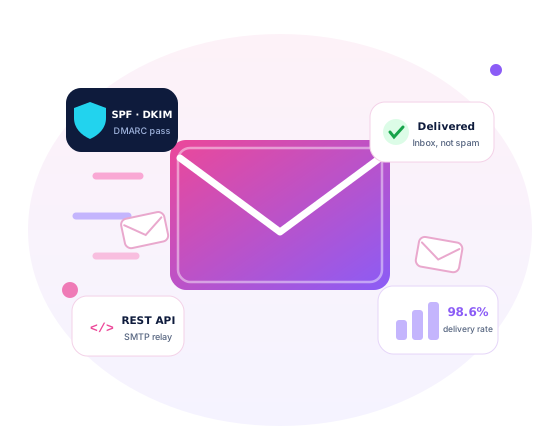
The mail your product cannot afford to lose
An OTP that arrives late is a failed login. A receipt in spam is a support ticket. An invoice that bounces is late revenue. Transactional mail is production infrastructure — we build and run it that way.
One API call — or plain old SMTP
Developers get a REST API with JSON payloads, template variables and sandbox keys. Everything else — the ERP, the school software, the WooCommerce store, the billing tool — simply points its existing SMTP settings at our relay and inherits proper deliverability without touching a line of code.


Watched like production, because it is
Every send is tracked from accept to delivery, bounce or complaint. Bounce spikes page a human, hard failures auto-suppress, and DMARC reports are actually read — weekly, by an engineer, not a dashboard nobody opens. When a mailbox provider changes behaviour, we adjust before you notice.
Authentication first, reputation always
Domain authentication, done in the right order
We publish SPF, DKIM (2048-bit keys) and DMARC so alignment is actually correct — then walk enforcement up from monitoring to quarantine to reject as the reports prove clean. Done backwards, the same three records silently shred your own legitimate mail; we see it weekly on domains we inherit.
Reputation is then managed like capacity: warm-up schedules for new IPs, shared-versus- dedicated guidance based on your real volumes, and list hygiene that never lets a stale address rot your sender score. For DPDP-conscious senders — banks, clinics, schools — an India-region option keeps message content, logs and archives in-country.
The deliverability runbook
- SPF, DKIM and DMARC configured, aligned and continuously monitored
- Staged DMARC enforcement: none → quarantine → reject, reports reviewed
- IP warm-up plans — volume ramped over 2–6 weeks on new dedicated IPs
- Shared pool vs dedicated IP recommendation from your actual traffic
- Hard bounces, complaints and unsubscribes auto-suppressed
- Feedback loops with major mailbox providers wired in
- TLS in transit by default; India-region hosting on request
Small API surface, serious plumbing underneath
Templates with variables
Versioned templates with variable substitution and per-language variants — preview test renders before a single real customer sees one.
Webhooks for every event
Delivered, opened, clicked, bounced, complained — signed webhooks to your endpoints with automatic retries, so your app always knows mail state.
Idempotency keys
Network blips and client retries never double-send an invoice or OTP — repeat a request with the same key and it counts exactly once.
Sandbox mode
Full API behaviour with zero real delivery: seed inboxes for staging, deterministic responses for CI, and no accidental mail to production users.
Per-stream analytics
OTPs, receipts and alerts run as separate streams with their own subdomains, reputation and dashboards — one noisy stream never drags down the rest.
5-year audit archive option
Immutable copies of regulated mail — statements, invoices, notices — searchable and exportable when the auditor or the customer dispute arrives.
Same message, different fate
Mailbox providers decide where your mail lands before they read a word of it — on your authentication, your IP and domain reputation, and your complaint history.
Inbox placement: shared hosting mail vs an authenticated dedicated stream
Illustrative inbox-placement ranges for otherwise identical content; actual results vary by mailbox provider, volume and history. The pattern, however, is stubbornly consistent.
Five steps to trusted sending
Verify domain
Prove DNS ownership; pick sending subdomains per stream — otp, billing, alerts.
Authenticate
SPF, DKIM and DMARC published and verified aligned with live tests.
Integrate
REST API or SMTP relay — sandbox first, then least-privilege production keys.
Warm up
Volume ramped on a schedule while seed inboxes verify placement.
Monitor
Dashboards, DMARC reports and bounce alerts — humans on call 24×7×365.
Predictable tiers, no surprise overage
| Plan | Monthly volume | Price (indicative) | Includes |
|---|---|---|---|
| Dev | 3,000 emails/mo | Free | Full API and SMTP, sandbox, 1 domain, community support |
| Growth | 50,000 emails/mo | ₹850/mo | 3 domains, webhooks, per-stream analytics, email support |
| Scale | 250,000 emails/mo | ₹2,900/mo | Priority queues, archive option, named support contact |
| Dedicated IP | Add-on | ₹1,500/mo | Your own IP with a managed warm-up plan — for sustained high volume |
Migrating from SES, SendGrid or Gmail SMTP
We run migrations without a big-bang cutover: templates mirrored, suppression lists imported (people who bounced or complained are never mailed again), then both providers run side by side on separate subdomains while traffic shifts stream by stream with placement watched. Gmail-SMTP senders get immediate relief from daily caps and breaking app passwords; SES and SendGrid users usually keep their code and swap credentials.

Transactional mail — straight answers
Why not just send through Gmail SMTP?
When do I actually need a dedicated IP?
Can you take our domain to DMARC p=reject?
What about attachments and message size?
Where are your servers, and where does our data live?
Can I send newsletters or bulk marketing here?
Transactional Mail — 20 questions, answered straight
The most-asked questions on the web about this topic, answered honestly by our team.
What is transactional email?
Why do my emails go to spam?
What are SPF, DKIM and DMARC in simple words?
What is a good delivery rate for transactional email?
Can I send transactional emails from my Gmail or Google Workspace account?
What is an SMTP relay?
What is the difference between transactional and marketing email - and why does mixing them hurt?
How much does transactional email cost?
What is a dedicated IP and do I need one?
What is IP or domain warm-up?
What is an acceptable email bounce rate?
Should I send email through an API or SMTP?
How fast should an OTP email arrive?
Why are my OTP emails delayed or missing?
What is a suppression list?
Do the Gmail and Yahoo bulk sender rules affect transactional email?
What do the DMARC policies p=none, p=quarantine and p=reject mean?
Do I need user consent for transactional email under Indian law?
Should I track opens and clicks on transactional email?
Can Addroit Nexus run transactional email for my application?
Have a project in mind? Let's talk.
Tell us what you are building or what is slowing you down — we reply with a clear, honest plan.
- Response within one business day — usually much faster
- You talk to engineers, not a sales script
- Your details stay with us — see our Privacy Policy
Cloud & Data Centers — latest headlines
- India’s Data Centre Capacity Set to Quadruple by 2030: Rubix Data Sciences Report - Convergence Now
- Sovereign by Design: Rebuilding the Cloud Stack for India’s AI Era - CXOToday.com
- India Healthcare Cloud Computing Market Size and Statistics – 2035 - Market Business Insights
- Tier-2 and Tier-3 Cities as Emerging Hubs in India’s Data Center Growth Story - Nasscom
- AWS Breaks Ground On New Hyderabad Data Centre, Reaffirms Over $21 Billion India Cloud And AI Infrastructure Investment By 2030 - Swarajya
Curated from public sources for your convenience — each story opens with full credit and a link to the original publisher.