What is an AI photo gallery?
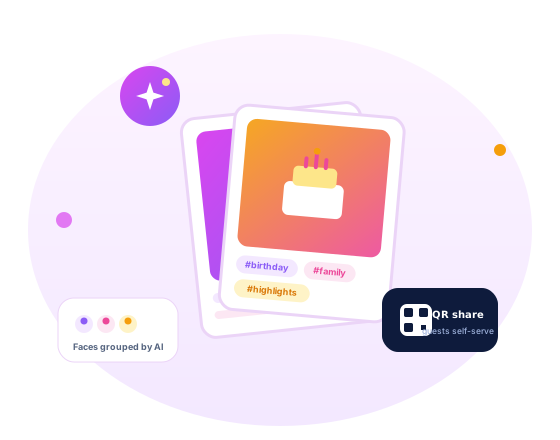
An AI photo gallery is an online album that organises itself. Instead of leaving you to scroll through thousands of files, software groups pictures by the people in them, detects events and moments, sets aside duplicates and blurred frames, and lets you search in plain words. The result is a private, shareable gallery of your event where anyone can find a specific person or moment in seconds rather than hours.
How does face recognition grouping work?
The software converts each detected face into a numeric signature that describes its geometry, then clusters similar signatures together. Every cluster becomes a person album, so all photos of one guest sit in one place, and you can merge, rename or hide clusters as you like. Matching works on these signatures, not on names or identities — the system only knows who someone is if you choose to type a name.
Is face recognition safe and private for family photos?
It can be, provided the provider treats faces as sensitive personal data. Look for private, link-restricted galleries rather than public pages, encrypted storage, a promise of no advertising use, guest opt-in for selfie matching, and a clear deletion policy that covers both the photos and the face signatures derived from them. India now has the DPDP Act, which gives people rights of consent and erasure — a trustworthy service will state plainly how it honours them.
How do guests find their own photos in a large event gallery?
The host shares a private link or a printed QR code. A guest opens it, takes one selfie and consents to matching; the gallery then shows every photo and video moment they appear in. There is no account creation, app install or password. Guests who prefer not to use selfie matching can still browse the full gallery or search by moment, and they can ask the host to hide particular photos.
Can I share the gallery on WhatsApp?
Yes. Sharing is a simple link that opens in any phone browser, so it travels well on WhatsApp — to individuals or to the big family group. Good galleries also produce WhatsApp-friendly highlight clips sized for Status. Because you share a link rather than files, you are not pushing hundreds of megabytes into the chat; relatives on slow connections open what they want and download originals only when needed.
What happens to my photos after the event — how long are they kept?
A reputable service states its retention period up front and deletes on schedule or on request. Smriti AI event galleries include one year of hosting; before expiry you can extend, download everything in original quality, or ask for deletion. When a gallery is deleted, the photos, the videos and the face-matching data derived from them are removed together — deletion that quietly keeps biometric signatures is not real deletion.
Do I keep the original quality of my photos and videos?
A well-built gallery stores your originals untouched and uses compressed copies only for fast browsing. The full-resolution files — including RAW photos and 4K video where uploaded — remain downloadable at any time by you and by anyone you permit. Before choosing any service, confirm two things in writing: originals are preserved exactly as uploaded, and a full-quality export of the entire gallery is available without punitive exit fees.
How much storage does a typical Indian wedding need?
A two-photographer wedding commonly produces 3,000 to 6,000 photos, which is roughly 30 to 120 GB, and two to six hours of video adding another 50 to 300 GB depending on resolution. Multi-day celebrations with haldi, mehendi and sangeet can double this. Most families land between 100 and 400 GB in total. Galleries priced per event rather than per gigabyte spare you this arithmetic entirely.
Can it make highlight reels automatically?
Yes. AI models score footage for faces, smiles, motion and key moments — varmala, cake cutting, the first dance — and assemble reels of sixty to ninety seconds, usually with music and vertical framing for Instagram and WhatsApp Status. Treat them as strong first drafts: you can reorder scenes, swap clips or trim before sharing. They complement the cinematic film your videographer edits by hand; they do not replace it.
Can I search the gallery in Hindi?
Smriti AI supports search in Hindi and English, including everyday event words such as haldi, mehendi, sangeet, pheras and vidaai, so grandparents can type the way they actually speak. Searches can combine people and moments — for example, bride with grandmother during haldi. Voice input works through the phone keyboard microphone. If your family prefers another Indian language, tell us; moment labels can be customised per gallery.
What if I or a guest wants certain photos removed?
Removal should be a right, not a favour. The host can hide or permanently delete any photo, and guests can flag images of themselves for removal — useful for unflattering frames or private moments captured by accident. Under the DPDP Act a person may withdraw consent and ask for erasure of their personal data, face data included, and a compliant gallery must honour that within a reasonable time.
Do photographers and studios get a white-label version?
Yes. Smriti AI has a white-label plan where studios deliver galleries under their own name, logo and domain — clients see the studio brand, not ours. Studios get bulk upload, per-event workspaces, client hand-off controls and optional watermarking for proof galleries. Pricing is per event or by monthly subscription depending on volume; both are indicative until quoted, so mention studio partner when you write to us.
What does an AI wedding gallery cost in India?
Indian market rates currently run roughly ₹5,000 to ₹25,000 per wedding depending on photo volume, video processing and hosting duration. As an indication, Smriti AI wedding galleries start around ₹7,999 for photos only and ₹14,999 with video highlights, each including a year of hosting, GST extra. Recurring plans for studios and stores work out cheaper per event. Every figure here is indicative — the honest final number follows a look at your actual media volume.
How long does processing take after I hand over the files?
For a typical wedding — a few thousand photos and several hours of video — Smriti AI usually returns a fully grouped, searchable gallery within about 48 hours of receiving the media. Very large multi-day events or drone-heavy 4K footage can take longer, and we flag that in advance. You review the draft, rename people and hide anything private before the gallery goes live to family or guests.
Are videos supported, or only photos?
Both. Videos are indexed moment by moment, so a person album includes the video scenes someone appears in, not just their photos. Long ceremony recordings become navigable chapters — you can jump straight to the pheras instead of scrubbing through three hours of footage. Highlight reels are cut from this same index, and the original video files stay downloadable in full resolution exactly as your videographer delivered them.
Is consent needed from guests for face recognition?
Yes — treat consent as mandatory, not as a courtesy. Face data is sensitive personal information, and under the DPDP Act it requires informed, specific consent. The clean pattern is opt-in: guests themselves choose selfie matching to find their photos, which is consent expressed in action, and anyone can decline and simply browse. Hosts should tell guests the gallery exists, and any guest can ask for their images to be hidden or erased.
Can showrooms and retail stores use it for product catalogues?
Yes — the same technology that groups faces can group products. Staff photograph stock on their phones; the gallery auto-tags category, colour and variant, so a jewellery set or a saree design becomes findable in seconds. QR codes on displays open the full catalogue, and festive lookbooks or new-arrival reels export straight to WhatsApp and Instagram. It suits jewellery, apparel, furniture, electronics and vehicle showrooms alike.
Can I view the gallery offline?
Galleries are web-based, so browsing needs a connection, though pages are built light enough for ordinary 4G. For offline use, download originals or curated albums to your phone or a hard drive — a full-quality export of everything you own is part of the deal. Many families keep the online gallery for sharing and a downloaded copy as the long-term archive, which is simply good backup practice anyway.
Where is my data stored?
Addroit Nexus stores Smriti AI galleries encrypted on Indian infrastructure — the media does not leave the country, which matters for DPDP compliance and for fast loading on Indian networks. As our Lucknow edge data center comes online, galleries will be able to sit in Uttar Pradesh itself. Access is by private link with optional expiry, and staff access is logged and limited to the support you actually request.
How is this different from Google Photos?
Google Photos is a personal library; an event gallery is a shared, purpose-built space. The differences that matter: guests serve themselves by selfie without joining your account; the host controls hiding, expiry and branding; studios can white-label it; search understands wedding moments; and a paid private service has no reason to mine your memories for advertising profiles. For one event shared with hundreds of people, that model simply fits better.